Part of the “Effective Budgeting” series.
Full representation: Only the full House and Senate can adequately represent the American people. Then-Speaker Kevin McCarthy aspired for committee memberships to be microcosms of the conference, but this laudable goal can only be imperfectly realized.
Holistic and robust: Floor deliberation can surface tradeoffs across all areas of the budget. A real budget with all spending and revenue, built from contributions by many members in committees and on the floor, can be robust enough to succeed despite members’ differences.
Expertise, then coordination: The first pass at managing programs taps members’ committee-focused expertise. Those initial decisions must then be open to revision by the entire body, within guardrails, especially to resolve conflicts and to coordinate programs between committees.
Recapping the Earlier Phases of Effective Budgeting
Start on time: Timely information from CBO and the White House can get Congress off to a good start. Holding off on the State of the Union can motivate the president to push the Office of Management and Budget and the National Security Council to send Congress the president’s budget request and the national security strategy sooner.
Budget blueprint: Committee views and estimates – their work plans for the year – should include line-item budgets and a clear sense of goals. This information helps the Budget Committees build a budget resolution with enforceable toplines for each committee, which could incorporate budget targets. Should Congress not adopt a budget resolution by April 15, the Budget Chairs would deem committee allocations at the baseline.
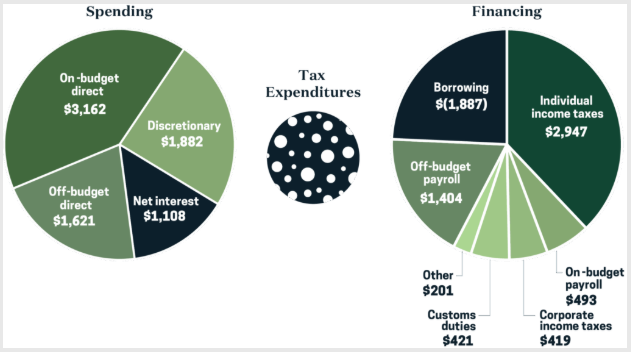
Building the budget bill: After committees manage their portfolios, the Budget Committees receive, validate, and integrate committees’ separate submissions into an annual budget act that covers all spending and revenue. The Budget Committees can keep the process moving by inserting current-law line items for a noncompliant committee. All committees produce reports to accompany their contributions. As Figure 1 shows, a real budget includes but goes well beyond the twelve appropriations bills.
Figure 1: A real budget includes all spending and revenue (FY2027, $ billion)
Source: CBO
On the House Floor
Blue slip: The House of Representatives should take up the annual budget act before the Senate does. That’s where, as the body closest to the people, the Constitution states that “All Bills for raising Revenue shall originate in the House of Representatives.”
Guardrails: A comprehensive budget on the floor will attract a wide range of ideas, prudent and otherwise. As introduced, the Comprehensive Congressional Budget Act would not strictly limit allowable policies like the Byrd Rule for reconciliation: it indicates that policies “should” have a fiscal impact, but it is not binding.
Fiscal integrity: The budget components and amendments must comply with parameters of the budget resolution and applicable rules and statutes, including budget targets. This means proposals must remain within the boundaries of spending, revenue, deficit, and debt aggregates for the budget year and subsequent years. Deficit-neutral reserve funds for specified purposes and the Budget Chair’s general authority to adjust aggregates will be useful when Congress can manage across the entire budget.
House rule: The special rule for considering the annual budget act will set time for general debate, determine which amendments will be made in order and how to sequence them, and can reinforce budget statutes, rules, and the budget resolution.
Time expectations: The federal budget is vast and thick with deferred maintenance. The time involved will depend on many factors, but it is entirely reasonable for each house to spend several full weeks on the one piece of legislation that touches everything and everyone and that provides structure for everything else Congress does.
Floor amendments: The House Rules Committee labors mightily to sift through proposed amendments, but decisions sometimes seem to be made in a black box. Especially for legislation with as broad scope as an annual budget act, coalition-focused, rule-of-law practices for filtering amendments could reduce many low-salience ideas, reserve floor time for amendments with built-in coalitions, and promote the intra-House outreach and negotiation that strengthen relationships and advance a more cohesive Congress that can more regularly adopt bipartisan solutions to Americans’ challenges.
Ordering debate: As noted in the prior post, the order of the divisions of the annual budget act matters for floor consideration. Putting the twelve appropriations subcommittee bills first would ensure that appropriators manage floor time for any amendment touching a provision of an appropriations measure, as amendments usually are taken up in the order that they would first amend the bill.
Passing the budget bill: By the end of this process, every member would have had the chance to advance priorities in committees and on the floor. Many members would have earned a significant stake in the annual budget act and would be inclined to support it, even if they disagree with the majority on other issues. Trying and failing at least reduces claims of being shut out.
To the Senate and beyond: The Senate would likewise benefit from a more open, rule-of-law process for filtering amendments, although the details are beyond the scope of this article. Once both houses pass a budget bill, the standard procedures for resolving differences can apply. Naturally, consultations across committees, between the chambers, and with the White House take place throughout.
Kurt Couchman is a Senior Fiscal Policy Fellow at Americans for Prosperity.