
Socialism is getting more attention. And it’s easy to understand why.
Your paycheck buys less than it used to. Rent keeps climbing. Groceries cost 25% more than they did a few years ago.
But before debating the merits of socialism versus capitalism, it’s important to understand the difference.
It comes down to who decides — who owns businesses and property, who decides what gets produced, and who sets prices.
For over 250 years, individuals reacting to market forces have made those decisions. Socialism leaves it to government.
Socialism vs. capitalism: Who owns and controls the economy?
Socialism is an economic system where much of the economy — including the businesses, industries, and resources people depend on — is publicly owned or controlled rather than privately owned.
That’s not the same thing as the existence of government programs. Public schools, Medicare, Social Security, and the interstate highway system don’t make an economy socialist on their own.
The real dividing line is ownership and decision-making: who controls the resources, who decides what gets produced and when, and who gets to make the final call.
In a capitalist economy, people can own property, start companies, invest their own money, compete for customers, and respond when demand shifts.
Under socialism, much of that individual freedom shifts to government. It owns or controls major industries, decides what gets produced and how much, sets prices, and can control services like health care. And, if you don’t like the result, there may be few alternatives.
Put capitalism vs. socialism side by side and the differences get a lot clearer:
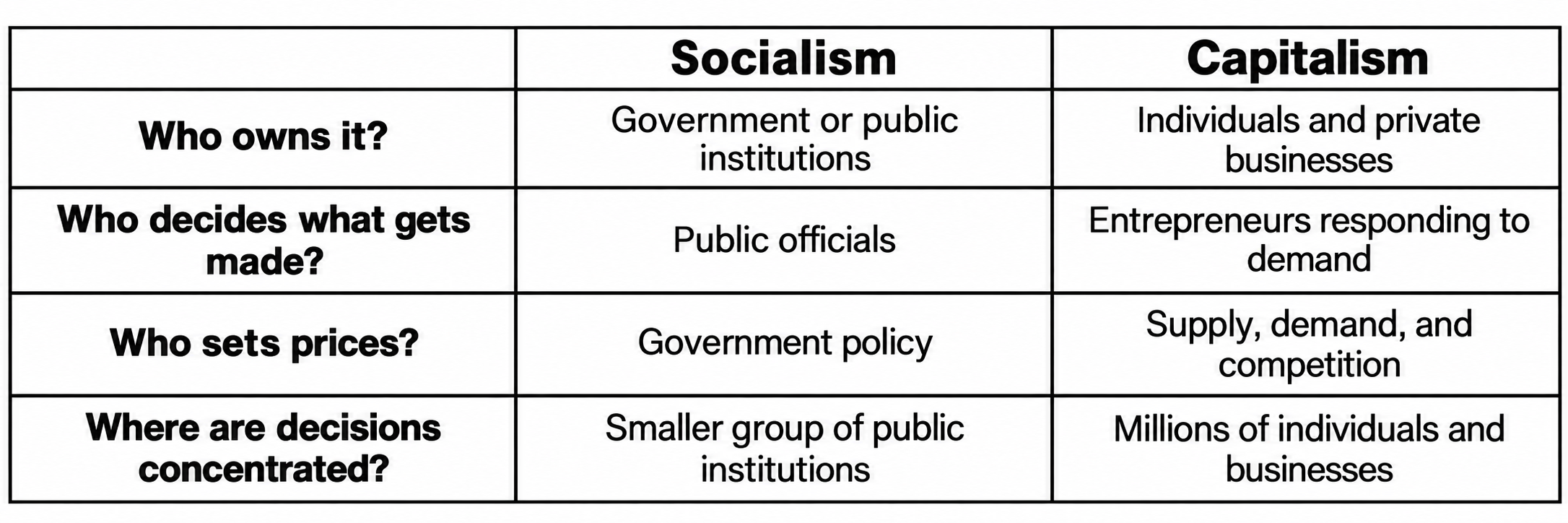
How markets and competition change who makes the decisions
Markets shape everyday decisions, starting with prices.
When the cost of eggs, apartments, or gas change, that’s a signal about supply and demand. Producers decide whether to make more. Consumers decide whether to buy less, switch products, or shop somewhere else.
Price controls work differently. Rather than allowing supply and demand to set prices, government sets limits on what businesses can charge. When the price is too low, businesses will produce less or stop selling it altogether.
Competition means you have more options and businesses are incentivized to meet demands. When several businesses want your money, each has a reason to offer something better — a lower price, better service, a stronger product, or a new idea.
Public ownership shifts those decisions. When government becomes the main provider in a sector, public officials, not customers, end up calling the shots on pricing and investment.
Are decisions spread among millions of people or concentrated in a handful of offices?

What does the difference look like in everyday life?

The difference is clear when you look at recent examples — housing, groceries, and health care.
- Housing: When government limits what landlords can charge, there’s less incentive to build. And scarcity drives up prices. For example, the city of St. Paul capped rents and, as a result, permits for new apartments fell from more than 2,000 a year to 404.Fewer permits meant fewer homes, and rent climbed right back up. See more examples from AFP’s Fight Socialism campaign. The better path forward is clearing away the zoning rules and permitting delays that keep builders from building.

- Groceries: New York City is planning to open government-run grocery stores designed to offer lower prices. But they pay no rent and no property taxes.As a result, the family-owned store down the block gets undercut, not by better prices or services, but by a subsidy it doesn’t receive. That’s not competition. That’s taxpayers propping up one store while the honest competitor next door pays both.Lower prices come from making it cheaper to stock a shelf everywhere, not from picking one winner and paying its bills.
- Health care: Medicare for All puts government in charge of financing health care, deciding what’s covered and who gets it. It would take private insurance from 180 million Americans.Look at countries that already made this trade: the typical wait from referral to treatment in Canada is 28.6 weeks. And the bill for treatment doesn’t disappear. It just moves from your wallet to your calendar. Read AFP’s take on government-run health care plans.

How to evaluate socialism vs. capitalism in everyday life
The real test is simple and goes beyond a label: does the call stay with people, or does it move to government?
And AFP’s answer hasn’t changed – more of those decisions should stay with individuals, entrepreneurs, workers, businesses, and consumers.
Capitalism bets that people closest to their own lives will find the best solutions to their problems.
Socialism thinks government has the answers.
Want to learn more about AFP’s perspective on socialism and eonomic freedom?
Explore our Fight Socialism campaign and ways to get involved.