ARLINGTON, VA— ICYMI: For years, Americans for Prosperity (AFP) has made the case that fixing America’s broken permitting system is essential to lowering the cost of living, creating jobs, and unleashing American energy. This week, we’ve continued to urge Congress to pass BAAJA quickly.
Now, three of the country’s leading editorial boards are urging Congress to take the permitting reform deal on the table. All three focus on affordability. Here’s what they’re saying:
New York Times Editorial Board: “Democrats, Take the Deal”
November 12, 2026
- The bill delivers on affordability. The board says the current system raises energy costs by keeping new projects, including cheap wind and solar, from coming online. In its words, “The status quo is expensive, dirty and unstable.”
- Waiting is a bad bet. President Trump would almost certainly veto a Democratic rewrite next year, and time matters for climate goals.
- Delay has real costs. Long-distance power lines typically take five to 13 years to build. The Quebec-to-New England line took about a decade and is projected to save consumers $50 million a year.
- Data centers pay their own way. The bill requires data center operators to cover the full cost of the electricity they use, protecting everyday ratepayers.
- A wide coalition. Backers include Senators Heinrich, Schatz and Whitehouse, plus Georgia’s Ossoff and Warnock, who voted to advance the bill.
Washington Post Editorial Board: “A major step toward historic permitting reform”
November 9, 2026
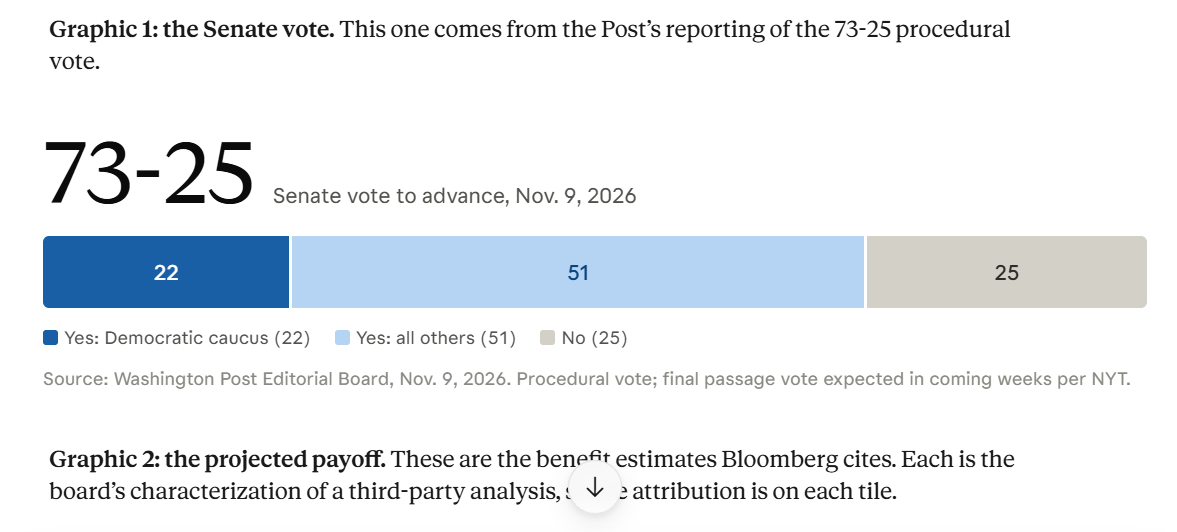
- A broad, bipartisan vote. The Senate advanced the deal 73-25, including 22 members of the Democratic caucus, a strong sign it will pass the chamber. The board says it could be a “historic achievement” after decades of failed efforts.
- Affordability is the argument. Democrats won the midterms promising to make life more affordable, and defending a bureaucracy that drives up energy prices clashes with that message.
- The coalition keeps growing. Late amendments won over holdouts, including the Edison Electric Institute. Climate groups such as Evergreen Action, Citizens’ Climate Lobby and the Environmental Defense Fund, along with several trade unions, are backing the compromise.
- Critics’ claims don’t hold up. The board says the bill expressly limits the executive branch from interfering with energy projects after they’re approved.
Bloomberg Opinion Editorial Board: “Democrats Should Take the Permitting Deal They Have”
November 11, 2026
- A rare bipartisan win within reach. The board says Congress is on the cusp of a major victory, and that crossing the finish line will take “prudence, resolve and common sense.”
- What the bill does. It streamlines environmental review, limits obstructive litigation, curtails capricious executive-branch actions, encourages green energy, expands transmission and gives companies and investors far more certainty.
- Support is wide. Backers include industry, clean energy producers, many climate groups, business leaders, numerous unions, much of the Senate and the White House.
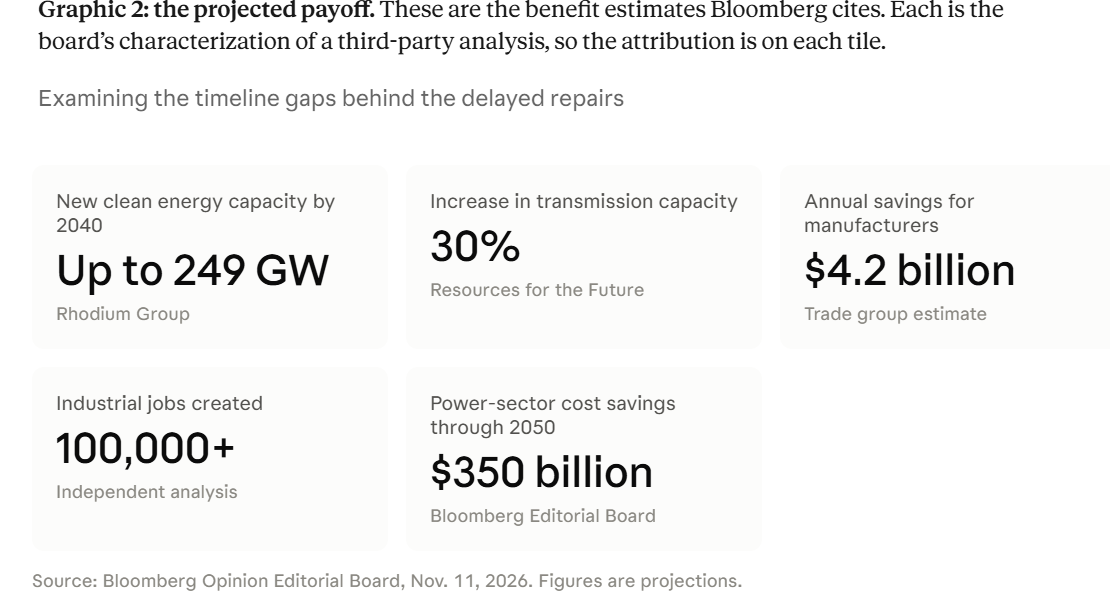
- The benefits are striking. Citing Rhodium Group, the board says the bill could add up to 249 gigawatts of new clean energy capacity by 2040. One trade group estimates $4.2 billion a year in savings for manufacturers, another analysis projects more than 100,000 industrial jobs, and the board says power-sector costs could fall by $350 billion through 2050.
- The backlog is enormous. About 2,060 gigawatts of generation and storage requests, roughly 1.5 times total existing capacity, are stuck in transmission bottlenecks. Even after recent reforms, fewer than half of environmental impact statements are finished within two years.
- Relief for consumers. The board says red tape drags on growth, raises prices and costs jobs, mostly to the benefit of lawyers. It argues an electorate fed up with rising prices would welcome lower electricity bills.
- Waiting won’t produce a better bill. The board says the bipartisan compromise may not survive future elections. It also notes Democrats failed to strike a deal in 2022 despite a governing trifecta.
Bottom line: Three editorial boards, three angles, one message. Permitting reform lowers costs, the deal is on the table, and Democrats shouldn’t wait for a better one that may never come.
Read the full editorials: [WaPo link] | [Bloomberg link] | [NYT link]
Through broad-based grassroots outreach, Americans for Prosperity (AFP) is driving long-term solutions to the country’s biggest problems. AFP activists engage friends and neighbors on key issues and encourage them to take an active role in building a culture of mutual benefit, where people succeed by helping one another. AFP recruits and unites activists in all 50 states behind a common goal of advancing policies that will help people improve their lives. For more information, visit www.AmericansForProsperity.org
###