
Chairman Roy, Ranking Member Scanlon, and members of the subcommittee:
Thank you for the invitation to discuss a well-crafted balanced budget amendment (BBA) to the Constitution and related statutory upgrades. These are proven, neutral, practical tools that can help Congress improve budgeting, governance, and democracy itself. They can make congressional service more rewarding by extending the practical ability to exercise all legislative powers. The right kind of BBA can both support responsible budgeting and push Congress to fix itself.
Federal fiscal stress already undermines American prosperity and opportunity. The federal debt burden pushes up inflation and interest rates, crowds out investments that boost workers’ pay, polarize politics, and risk debt crisis and default. All Americans suffer from poor federal budgeting.
Many countries and U.S. states have faced similar challenges. Some have defaulted. Cross-ideological coalitions have made recovery possible through the policy changes needed to reduce borrowing and by improving their governing systems. Congress still has a narrowing window to prevent crisis.
Fortunately, newer proposals for a BBA and related statutes avoid the challenges of earlier attempts, as I discuss in a recent book.[1] In particular, a Principles-based BBA would let Congress enact implementing legislation to smooth budgeting over the business cycle and accommodate automatic stabilizers, emergency spending, and changes in revenue policy.
Congress should act soon to defuse the debt bomb, strengthen its legislative powers, and chart a thoughtful, well-considered path to sustainable finances. If, however, a debt crisis overtakes Congress, such solutions can help America bounce back faster and stronger.
This testimony has four parts. First, it reviews the growing federal debt burden’s harm to the American people and the risks of worse. Second, it discusses the art of drafting a BBA. Third, it considers implementing legislation and an effective budget process. Finally, it draws lessons for today from the competition that helped the House pass a BBA in 1995.
Excessive federal debt already hurts Americans, risks greater harm
Federal debt held by the public equals gross domestic product (GDP), the sum of all goods and services produced in the United States each year. The high and rising debt burden imposes steep costs and vulnerabilities.
Excessive spending and borrowing have caused most of recent years’ high inflation. The federal government borrowed so much and so fast that the Federal Reserve had to monetize it, especially after the $1.9 trillion American Rescue Plan Act of 2021.[2]
A high government debt burden pushes up interest rates and slows economic growth. World Bank researchers estimated that economically advanced countries lose 0.017 percentage points of annual economic growth for each percentage point increase in the debt burden above 77 percent of GDP.[3] That suggests America foregoes four-tenths of a percent of real growth each year, which compounds rapidly.[4]
“Any great power that spends more on debt servicing than on defense risks ceasing to be a great power,” says Ferguson’s Law.[5] In Fiscal Year (FY) 2025, $1.03 trillion in federal net interest outlays exceeded $868 billion in Department of Defense outlays, and only $1.57 trillion in outlays for Social Security was higher.[6]
Interest expense as a share of revenue is the highest since at least the Second World War. It exceeds the heights of the late 1980s through the mid-1990s that drove repeated rounds of usually bipartisan deficit reduction and nearly propelled a BBA to state legislatures for ratification.
The major credit ratings agencies have downgraded the federal government’s credit rating or outlook.[7] Several Treasury auctions have been weak,[8] and the city of Chicago just showed that indulging fiscal fantasies has a price.[9] Even longtime deficit doves like former Biden advisor Jared Bernstein have concluded that the federal government is “inviting a debt shock.”[10] A BBA is, in fact, in the interests of all Americans – Democrats,[11] Republicans, and independents.
The U.S. Congressional Budget Office, the U.S. Government Accountability Office, and virtually all independent observers agree that the U.S. Government’s fiscal path is unsustainable. Most hesitate to predict the timing of a debt shock, but all expect the risks to grow as the debt burden increases.
Collapsing fiscal space coarsens American politics as well. Future Congresses cannot make good on every promise made by earlier Congresses.[12] Many members of Congress know what must be done, but many do not know how to do it and survive politically. Institutional changes including a BBA can provide the right kinds of political cover and empowerment to protect the highest valued activities while foregoing those we can do without.
Best practices from the states and abroad can restore federal fiscal health and rejuvenate democracy within Congress. Members of Congress have introduced most of them already.
Designing a constitutional rule to control the debt
A fiscal responsibility rule has two basic elements: 1) the balance norm and 2) exceptions to the rule. If the budget is far from balance, another piece is needed: 3) a transition.
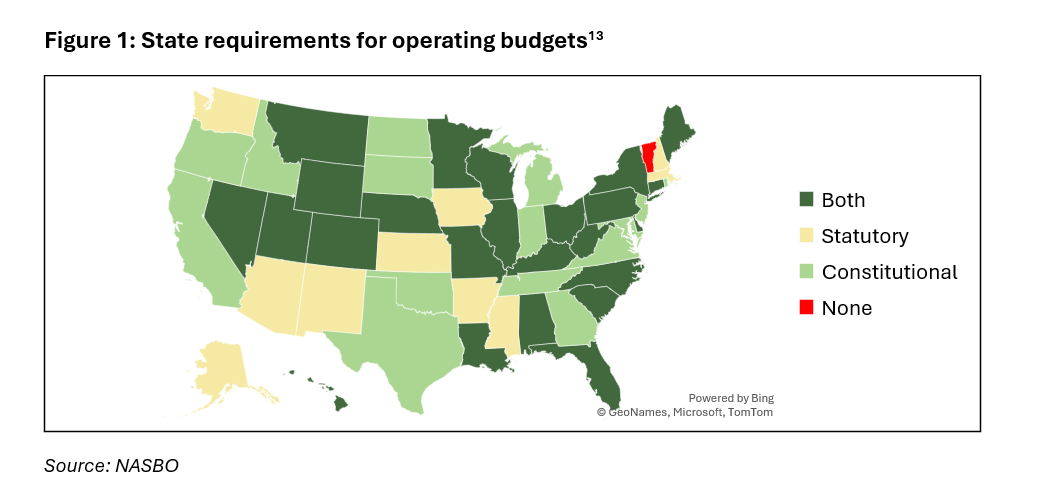
Nearly every state requires operating budget balance (Figure 1). Their forms vary, they apply at different stages of the process, and are constitutional, statutory, or both. Restoring access to bond markets at better interest rates when emerging from debt crises – and even default – in the 1840s and 1870s was a key driver. A constitutional component strengthens the commitment to sound budgeting by limiting allowable borrowing to specified circumstances.
Most economically advanced countries must balance their budgets as well (Figure 2). Like U.S. states, they have used policy changes and institutional upgrades to reduce budget pressures. The rules vary but usually have constitutional provisions with details in statute. Notably, countries with balanced budget rules tend to have stable or declining debt burdens except during emergencies but different visions for the size and scope of government.
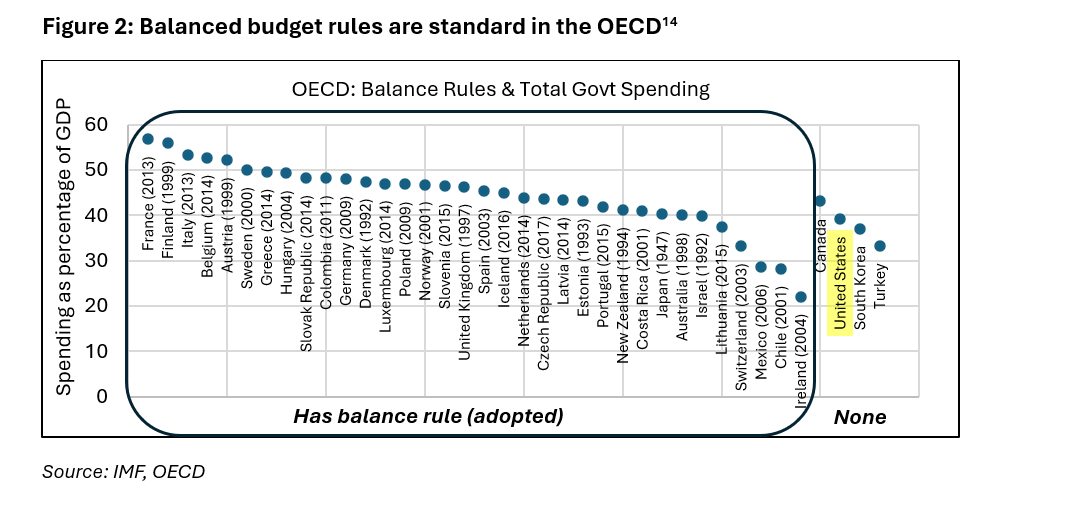
A general balance rule may be most appropriate for the U.S. Constitution as well. After all, many existing constitutional provisions are eternal principles that Congress fits to the country’s changing needs by enacting and amending statutes.
A clear set of principles may help the American people hold Congress accountable. More complicated, specific rules are more difficult to understand and can create more room for creative evasion. Constitutional provisions need not be textually “ironclad” to have a powerful influence on the behavior of public officials.
Principles may also be more able to attract and sustain the broad consensus needed to amend and uphold the Constitution. After all, the standard amendment path of two-thirds of both houses of Congress to propose and three-fourths of state legislatures to ratify is only available to widely supported and well-drafted ideas.
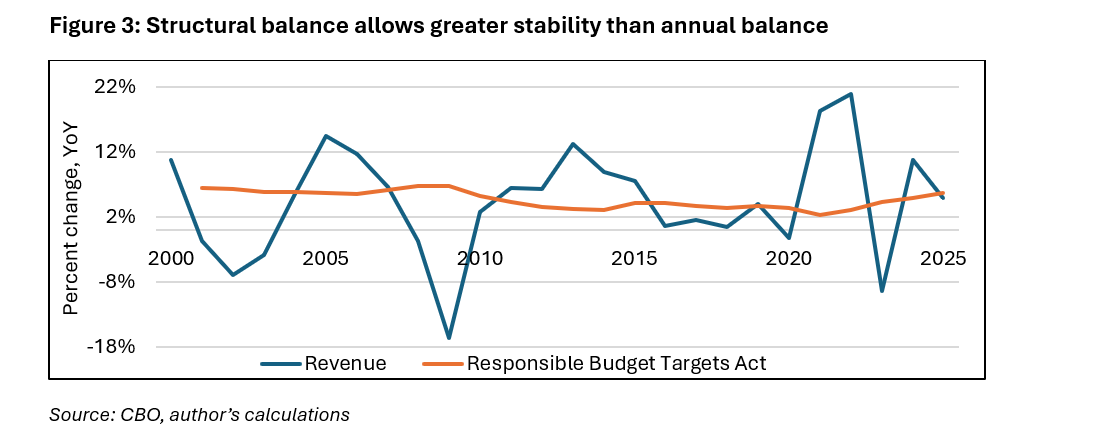
The American people overwhelmingly support a BBA. A 2023 poll found that 80 percent of Americans support “a constitutional amendment that would require a balanced budget within 10 years.”[15] Many economists have cautioned, however, that balance should be over the business cycle rather than every year.[16] Revenue is volatile, but smoothing spending over the medium term can harmonize policy stability with the rule of law (Figure 3).
Most introduced BBAs would require annual balance based on “outlays.” So has every version voted on by Congress. Congress does not control outlays directly – when funds leave the federal government – which would add management challenges to annual balance as compared to “expenditures” or another general term.
Numerous provisions that narrow a BBA’s appeal derive in part from the original sin of annual balance: excluding major programs, turning off balance during economic weakness, supermajorities to raise revenue or spend beyond some share of GDP, including the statutory debt limit, authorizing impoundments, prohibiting court intervention, and more.[17] Alternatives exist.
Multiple emergency thresholds can undermine a balance rule’s integrity, and in some cases, they could create a perverse incentive for military actions. Constitutionalizing the statutory requirement for the president to propose a budget could alter the balance of powers. Little time to reach balance would intensify the costs of the transition to balance.
Several BBA proposals are not hindered by these challenges. Rep. Jodey Arrington’s Business Cycle BBA[18] (BCBBA) would 1) limit expenditures to the average revenue of the three prior years, adjusted for inflation and population, 2) allow emergency spending with two-thirds support in both houses, and 3) specify a 10-year path to balance after ratification. Spending would be much more stable and predictable than under annual balance and would even be slightly countercyclical. An early version of the BCBBA had broad, bipartisan support including 14 Democrats and 46 Republicans.[19]
Rep. Nathaniel Moran and Senator Jon Husted’s Principles-based BBA (PBBA)[20] would simply 1) require balance with mechanics to be specified by statute, 2) allow emergency spending with two-thirds support in both houses, and 3) give Congress 10 years to reach balance after ratification. The core of PBBA’s implementing legislation could be Rep. Tom Emmer and then-Senator Mike Braun’s Responsible Budget Targets Act,[21] which would set up a glide path to structural primary balance.
Structural balance means balance over the medium term or over the business cycle, and primary balance excludes interest costs. The combination of the PBBA and the RBTA would resemble Switzerland’s effective and popular debt brake. The BCBBA and the PBBA would let Congress choose full or primary balance, which would require about half as much deficit reduction as full balance. Balance with the PBBA could mean three concurrent cycles: 1) structural balance for normal activities, 2) immediate spending and subsequent offsets for emergencies, and 3) financing capital investments up front with payments over assets’ useful lives.
A 10-year glide slope to primary balance is consistent with recent calls for a 3-percent-of-GDP deficit target and at least one way to implement Rep. Tom McClintock’s proposed debt limit amendment (Figure 4).[22] A path to primary balance would nearly stabilize the debt-to-GDP ratio in a decade, and Congress could later target primary surpluses to reduce debt drag further.

A BBA needs a safety valve for emergencies. The Constitution’s standard and highest legislative supermajority of two-thirds in both houses, such to as to override a veto, would let Congress respond quickly without being a frequently used loophole.
Finally, the federal government’s new borrowing is about $2 trillion per year, or about $1 trillion excluding interest expenses. It will take time for Congress to close that gap, and the American people should get to affirm or adjust which policymakers make those choices. A ten-year transition to balance after ratification would let that happen. Of course, Congress could and should move toward balance faster than the outer boundaries set by a BBA.
Statutory upgrades complement a BBA and let Congress keep faith
Most provisions of the Constitution depend on Congress passing statutes to say how those principles should apply to modern life. A newly enacted balanced budget provision would rely on statutes for definitions and duties, mechanics for balance and exceptions, and perhaps automatic enforcement. A Principles-based BBA would, by definition, leave the most scope for Congress to implement.
The Responsible Budget Targets Act’s gradual transition to structural primary balance is an exceptionally well-designed approach to statutory budget targets. It would provide stable, predictable, countercyclical, neutral, and comprehensive guidance for the federal budget. Total non-interest spending would grow with a rolling, five-year average of GDP growth, and that growth rate would slow, cumulatively, after primary deficits and increase after primary surpluses. That debt brake would reset when the budget first reaches primary balance. Emergency spending offsets would occur over the following six years. The spending targets would accommodate automatic stabilizers, changes in revenue policy, and more.
Automatic enforcement should abandon the ineffective, “goofy meat axe” of sequester that has nominally applied to caps on annually appropriated spending and has purportedly enforced the Statutory Pay-As-You-Go Act of 2010. A more credible way would spread budgetary savings around and over a longer period with a series of small, incremental adjustments to a wide variety of parameters in existing statute.[23]
Beyond direct implementing legislation, Congress’ underlying budget process is outdated and deeply dysfunctional. Most members have little opportunity to contribute to the annual budget work. Problems fester without the possibility of resolution. Decisions that committees could handle get pushed to leadership and reinforce a bipolar culture. Regular opportunities for responsible, bipartisan dealmaking are thin. These results flow from poor institutional frameworks.
Rep. Blake Moore’s Comprehensive Congressional Budget Act[24] would unleash Congress’ vast potential to solve problems while strengthening democracy within the body. In addition to the Appropriations Committees managing the 26 percent of spending that is “discretionary,” the sixteen committees with direct spending and revenue jurisdiction would also manage their portfolios. The Budget Committees would bundle other committees’ contributions and send the annual budget act to the floor.
A comprehensive budget would give Congress a politically viable, practical ability to meet reasonable targets while empowering all members to pursue their priorities in often-bipartisan deals across the budget. After all, nearly 90 percent of federal health subsidies are outside of the annual appropriations bills, as are most income support programs and the entire tax code.
More immediately, Rep. Jodey Arrington and Jimmy Panetta’s Prevent Government Shutdowns Act would help Congress focus on the art of the possible instead of engaging in brinksmanship and claiming leverage that does not exist.[25] The bill would largely return to the pre-Carter Administration practice of continuing programs until new appropriations are enacted while keeping Congress in Washington, D.C., until that work is done. Automatic continuing appropriations are a powerful tool to foster a strong, bottom-up legislature. Earning members’ votes for budget legislation increases their buy-in and makes trimming the fat easier.
Congress has many other ways to modernize the budget process and to support more regular authorizations.[26] Many of those options are less directly connected to implementing a balanced budget amendment, however, and will not be discussed here.
Re-building broad support for a BBA and related statutes
Finally, the House of Representatives passed a BBA in 1995 on a strongly bipartisan vote.[27] 72 Democrats and most Republicans voted for final passage in the House. It was the first and only time that a BBA cleared the two-thirds threshold in the House.
More recently, in 2011, BBA proponents would strategize in the office of a senior House Republican. One attendee suggested floor votes on multiple BBAs, but the host said the 1995 experience showed that multiple votes would let Democrats divide their votes to keep any BBA from passing.
Maybe that’s not the right lesson. Maybe members getting to vote first for a preferred version made it easier to vote for the consensus BBA as well.
The 1995 process started with a House Judiciary Committee markup. It added conservative provisions to H.J.Res.1 and ended only when remaining amendments largely rehashed topics that had already been considered. The Senate Judiciary Committee did likewise.
The special rule for the floor established a competitive, queen-of-the-hill process: the most popular substitute amendment becomes the text for final passage. The rule put the Judiciary-amended-to-be-conservative BBA first, then four Democrat-proposed versions, and finally the traditional BBA as introduced. In other words, they moved from more ideological versions to one that attracted more consensus and passed 300-132.[28]
The House-passed BBA went to the Senate, where the Judiciary Committee had already marked up S.J.Res.1.[29] After robust floor consideration, 12 Senate Democrats including then-Senator Joe Biden joined all Republicans except Oregon Senator Mark Hatfield to support it. H.J.Res.1 was one vote away from being proposed to state legislatures.
That BBA had substantial shortcomings including annual balance and multiple emergency thresholds, however, that do not apply to today’s next-generation proposals. These include Rep. Arrington’s Business Cycle BBA, Rep. Moran and Senator Husted’s Principles-based BBA, and perhaps Rep. McClintock’s debt limit amendment proposal.
To begin the process of rebuilding bipartisan support for a constitutional fiscal rule, the House could again employ a queen-of-the-hill competition. More ideological proposals could be considered first, and those more likely to attract consensus could be considered toward the end. In this way, members of Congress could rediscover which proposals have the broadest appeal and build on them in the years to come.
In conclusion: Which future will Congress choose?
The federal government’s debt burden already hurts Americans through higher inflation and interest and lower opportunity and prosperity. The growing debt risks a bond market reckoning with potentially dire consequences for the American people. The actions of their representatives in Congress will determine whether the conditions of the American Dream – peace, freedom, and prosperity – survive, or if the future is decline.
Federal budgeting is long overdue for modernization. New approaches to balanced budget amendments to the U.S. Constitution and statutory upgrades bring hope that Congress can revive itself, become a better place to serve, and solve a wide variety of pressing problems.
These are already proven, practical tools to restore sound governance. Yet the question remains: can members of Congress work together proactively to lead America to a better tomorrow, or must we live through avoidable pain and suffering first?
[1] Kurt Couchman, Fiscal Democracy in America: How a Balanced Budget Amendment Can Restore Sound Governance, Palgrave Macmillan, 2025.
[2] Kurt Couchman and Ilana Blumsack, “Bidenflation Blame Game: How Big-Spending Politicians Scapegoat Business,” Americans for Prosperity, June 2024.
[3] Thomas Grennes, Mehmet Caner, and Fritzi Koehler-Geib, “Finding the Tipping Point – When Sovereign Debt Turns Bad,” World Bank, July 30, 2010.
[4] Committee for a Responsible Federal Budget, “Income Growth Would Slow By One-Third Due to Rising Debt,” May 28, 2024.
[5] Sir Niall Ferguson, “Ferguson’s Law: Debt Service, Military Spending, and the Fiscal Limits of Power,” Hoover Institution, February 21, 2025.
[6] Congressional Budget Office, “Monthly Budget Review: Summary for Fiscal Year 2025,” November 10, 2025.
[7] Yun Li, “Moody’s downgrades United States credit rating, citing growth in government debt,” CNBC, May 16, 2025. Fitch Ratings, “U.S. Fiscal Outlook Remains Challenging Despite Near-Term Revenue Boost,” June 18, 2025. S&P Global, “U.S. ‘AA+/A-1+’ Sovereign Ratings Affirmed; Outlook Remains Stable On Steady, Albeit High, Deficits,” August 18, 2025.
[8] Gertrude Chavez-Dreyfuss, “Investors wary of Treasury’s 30-year bond auction after recent disappointments,” Reuters, September 10, 2025.
[9] “Editorial: The bond vigilantes are coming for the city of Chicago. Is the mayor paying heed?” The Chicago Tribune, November 24, 2025.
[10] Jared Bernstein, “Biden’s Chief Economist: The Chart That Convinced Me Our Debt is a Serious Problem,” The New York Times, July 9, 2025.
[11] Kurt Couchman, “A Balanced Budget Amendment is in Democrats’ Interests,” DC Journal, October 2, 2025.
[12] C. Eugene Steurle, Dead Men Ruling: How to Restore Fiscal Freedom and Rescue Our Future, Century Foundation, 2014.
[13] National Association of State Budget Officers, Budget Processes in the States, 2021, Table 9: Balanced Operating Budget Requirements, p. 61.
[14] IMF Fiscal Affairs Department, “Fiscal Rules Dataset, 1985-2024,” September 2025. OECD, “General government spending,” accessed November 29, 2025.
[15] Harvard-Harris Poll, July 2023 Key Results, p. 57.
[16] Ryan Bourne, “Economists Oppose a Strict Balanced Budget Rule. Could the US Adopt a Sophisticated One?” Cato Institute, November 13, 2017.
[17] Kurt Couchman, “Revisiting the Balanced Budget Amendment: Toward Designs Without Defects,” Americans for Prosperity, November 2023.
[18] Rep. Jodey Arrington, “Arrington Introduces Balanced Budget Amendment,” February 9, 2024.
[19] Rep. Justin Amash, H.J.Res.81, “Proposing a balanced budget amendment to the Constitution of the United States,” introduced October 14, 2011.
[20] Rep. Nathaniel Moran, “Congressman Nathaniel Moran Reintroduces Constitutional Amendment to Balance the Federal Budget,” July 23, 2025. Sen. Jon Husted, “Husted introduces constitutional amendment to balance the federal budget,” November 24, 2025. Kurt Couchman, “Introducing the Principles-based Balanced Budget Amendment, Americans for Prosperity, November 24, 2025.
[21] Kurt Couchman, “What is the Responsible Budget Targets Act?” Americans for Prosperity, June 21, 2023.
[22] Rep. Tom McClintock, H.J.Res.9, “Proposing an amendment to the Constitution of the United States prohibiting the United States Government from increasing its debt except for a specific purpose by law adopted by three-fourths of the membership of each House of Congress,” introduced January 3, 2025. The “Debt Penny Plan” would, each year, require Congress to reduce the projected debt-to-GDP ratio by one percentage point by the end of the following five-year period.
[23] Kurt Couchman, “Why incremental adjustments are a better approach to automatic budget enforcement,” Americans for Prosperity, March 23, 2023.
[24] Rep. Blake Moore, “U.S. Representatives Moore and Gluesenkamp Perez introduce legislation to reform the congressional budget process,” January 11, 2024. Kurt Couchman, “What is the Comprehensive Congressional Budget Act?” Americans for Prosperity, September 5, 2024.
[25] Rep. Jimmy Panetta, “Rep. Panetta Co-Leads Bipartisan, Bicameral Effort to Prevent Future Government Shutdowns,” November 3, 2025. Kurt Couchman, “What Leverage? Shutdown fights don’t get results,” The Hill, September 27, 2023.
[26] Kurt Couchman and Graham Owens, Building Up Congress: A Pocket Guide, Americans for Prosperity, November 6, 2025.
[27] Kurt Couchman, “BBA competition in the House can rebuild broad support,” Americans for Prosperity, August 20, 2025.
[28] U.S. House of Representatives, Roll Call 51, on H.J.Res.1 (104th Congress), January 26, 1995.
[29] Sen. Robert Dole, “S.J.Res.1, A joint resolution proposing an amendment to the Constitution of the United States to require a balanced budget,” introduced January 4, 1995.
© 2026 AMERICANS FOR PROSPERITY. ALL RIGHTS RESERVED. | PRIVACY POLICY
Receive email alerts to learn how to get involved