Today, the Oklahoma Secretary of State launched guidance.ok.gov, giving the public a searchable database for finding guidance issued by state agencies and guidance those agencies receive from the federal government. Oklahoma is the first state to require both categories of guidance to be disclosed in an indexed and searchable format.
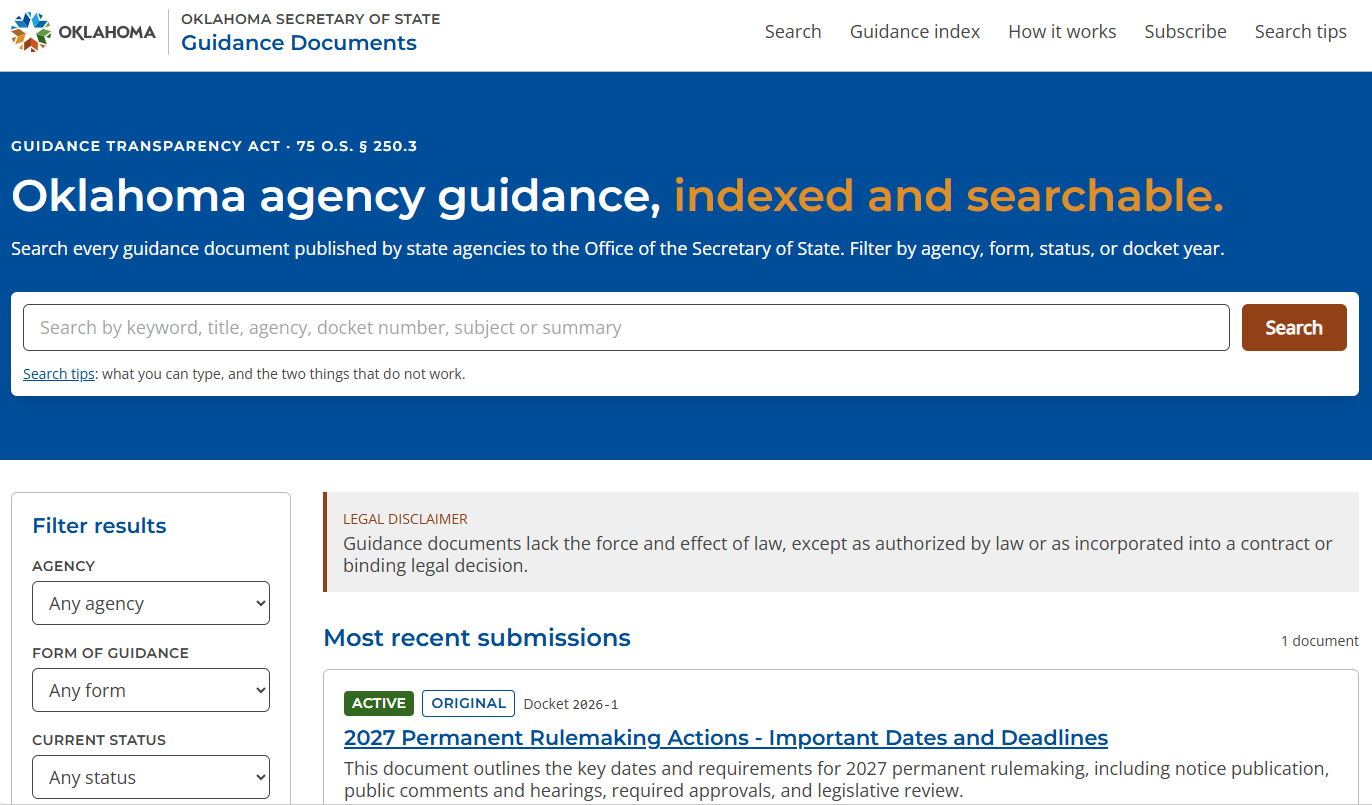
The portal implements the Guidance Transparency Act, enacted as SB 1433, sponsored by Senator Micheal Bergstrom (R-Adair) and Representative Rob Hall (R-Tulsa), and supported by Americans for Prosperity-Oklahoma. Under the law, agencies subject to Articles I and II of Oklahoma’s Administrative Procedures Act must submit guidance documents to the Secretary of State on a quarterly basis for online publication in a searchable format.
The portal also includes a disclaimer required by law that “[g]uidance documents lack the force and effect of law, except as authorized by law or as incorporated into a contract or binding legal decision.” Users can even subscribe for guidance updates by agency and choose to receive emails immediately, daily, or weekly.
The legislation draws on reform concepts advanced by Americans for Prosperity’s Guidance Out of Darkness Act (GOOD Act) and the Right on Transparency coalition’s Model Policy, which has been endorsed by nine right-of-center organizations committed to open government and accountability.
Why Guidance Transparency Matters
On both the state and federal levels, government agencies often issue guidance documents to interpret or clarify statutes and regulations. Although such guidance technically lacks the force of law, agencies frequently treat it as binding, using it to enforce interpretations without formal rulemaking and, in most cases, without public scrutiny. Further, after Oklahoma passed the REINS Act in 2025 requiring legislative approval of “major” rules, this legislation will ensure agencies do not try to circumvent that law by regulating through guidance.
Unlike regulations, guidance documents are not usually subject to the procedural requirements of the federal Administrative Procedure Act or its state-law corollaries. A guidance document, for example, is not typically subject to a public notice-and-comment period as with most rulemaking. Many of these guidance documents are sent to states to express the federal government’s views on the state’s obligations and programs they co-administer. Essentially, arcane federal guidance documents often impact state laws and policies.
Across the country, only eight states require agencies to publicly disclose certain guidance documents that shape policy. More states should act to protect residents, businesses, and local governments from hidden mandates by requiring full transparency for both federal and state guidance documents. Coupled with transparency, states should also conduct ongoing review of state agency guidance documents to prevent the accumulation of outdated or obsolete guidance.
Resources:
- AFP’s Model Legislation: Guidance Out of Darkness Act (“GOOD Act”)
- Right on Transparency: Model Policy endorsed by nine right-of-center organizations
Kevin Schmidt is Director of Investigations for Americans for Prosperity.