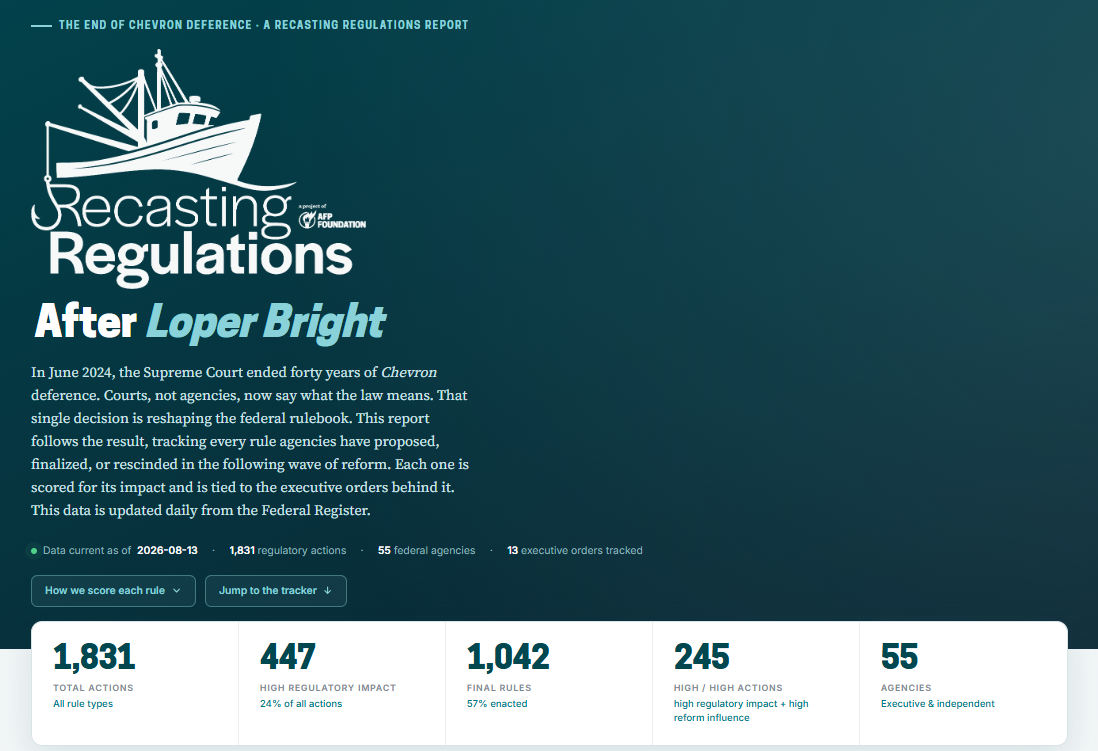
Loper Bright Enterprises v Raimondo began with Atlantic fishermen asking what gave Washington the right to make them pay for government monitors. Congress had never explicitly authorized industry-funded monitors for their fishery. The fishermen took their case to court and won, overturning the 1984 Chevron deference doctrine and ending the practice of courts deferring to agencies’ interpretations of ambiguous laws. The Loper Bright ruling opened the legal door for a broader deregulatory push that is now producing concrete results across trade and commerce. Now, all these changes can be tracked in one place using the Recasting Regulations Tracker.
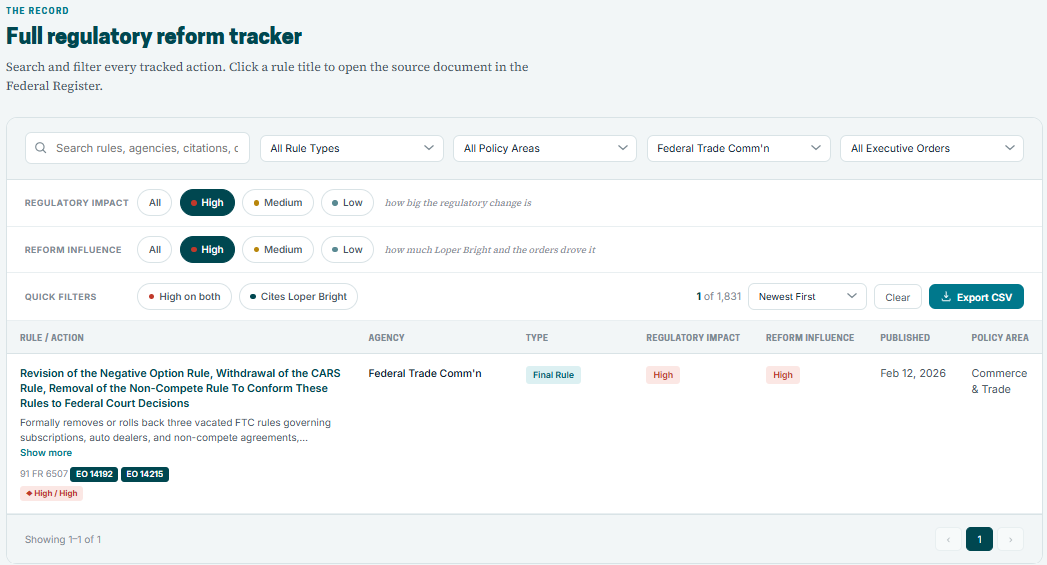
Judicial deference to an agency’s “reasonable” interpretation effectively handed the bureaucracy a carte blanche to turn statutory ambiguity into overreaching policies that Congress never authorized. After Loper Bright, however, courts are reining agencies back within their statutory mandates. The Federal Trade Commission (FTC) under the Biden administration tried to impose a nationwide ban on most non-compete agreements, regulating millions of private employment contracts without clear congressional authorization. A federal district court found that the FTC had exceeded its statutory authority, and the agency formally removed the rule (91 FR 6507) in February 2026. The principle is clear: agencies can no longer manufacture powers Congress never gave them.
The Loper Bright ruling also opened the legal space for the Trump administration to pursue a much more aggressive deregulatory program. Executive Order 14192 directed agencies to identify at least ten regulations for repeal for each new regulation issued, while keeping regulatory costs significantly below zero. On April 9, 2025, President Trump issued a memorandum directing agencies to use Loper Bright and nine other Supreme Court decisions as grounds to rescind unlawful regulations.
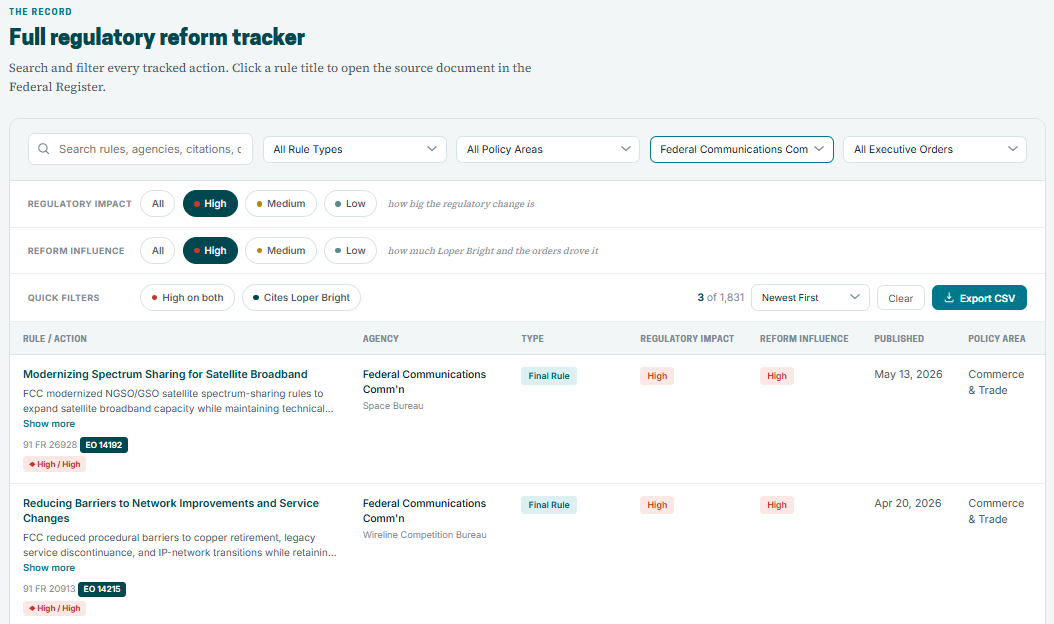
Since Loper Bright, federal agencies are increasingly removing barriers that prevent technological modernization and obstruct capital from moving toward higher-value uses. Recognizing that antiquated regulatory requirements were making the transition from copper telephone infrastructure to newer networks slower and more expensive, the Federal Communications Commission (FCC) issued a rule (91 FR 20913) streamlining requirements governing the retirement of legacy networks and eliminating duplicative obligations.
The FCC also replaced the framework (91 FR 26928) governing satellite spectrum-sharing limits that dated from the 1990s with updated, performance-based protections that allow greater private coordination among satellite operators. The FCC estimates that the reforms could generate between $1.6 billion and $19.9 billion in benefits over five years, while increasing network capacity by as much as 700 percent using the same number of satellites.
But not every downstream impact of Loper Bright makes for splashy headlines. Just as important is the more mundane work of regulatory hygiene: deleting dead programs, duplicative cross-references, obsolete reporting provisions, superseded labeling regimes, redundant FOIA provisions, and similar detritus. From the Small Business Administration’s streamlining of licensing requirements (90 FR 29794) rules to the Bureau of Economic Analysis (90 FR 42533) raising the threshold for short-form foreign investment filings, the downstream impacts of Loper Bright are helping the Trump administration make good on its deregulatory promises.
But there is more work to do. Agencies should continue prioritizing rules that rest on expansive interpretations of statutory authority, regulations written for industries and technologies that no longer resemble today’s markets, and requirements that raise the costs of doing business.
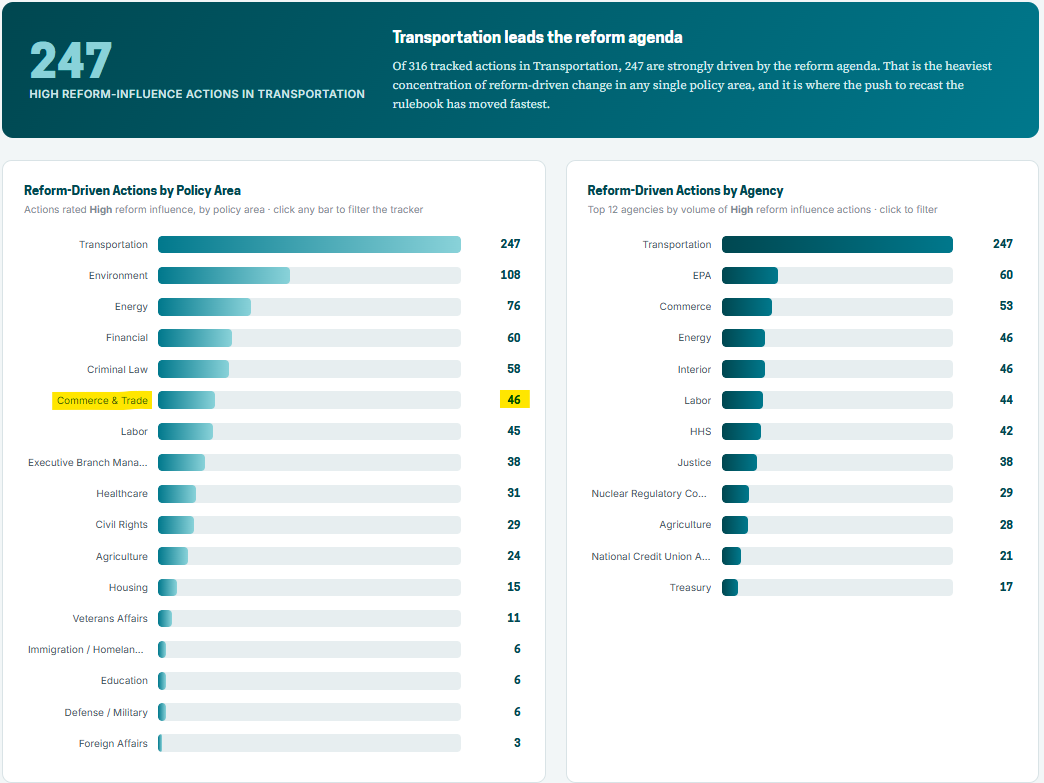
Americans for Prosperity’s Recasting Regulations Tracker shows how much progress has already been made. In trade and commerce alone, the tracker identifies 46 regulatory actions highly influenced by the post-Loper Bright reform effort. Yet these actions should represent a beginning rather than an endpoint. Loper Bright restored an essential check on the administrative state: the commonsense principle that agencies must operate within the authority Congress actually gave them.
Matthew MacKenzie is a Trade Policy Analyst at Americans for Prosperity.