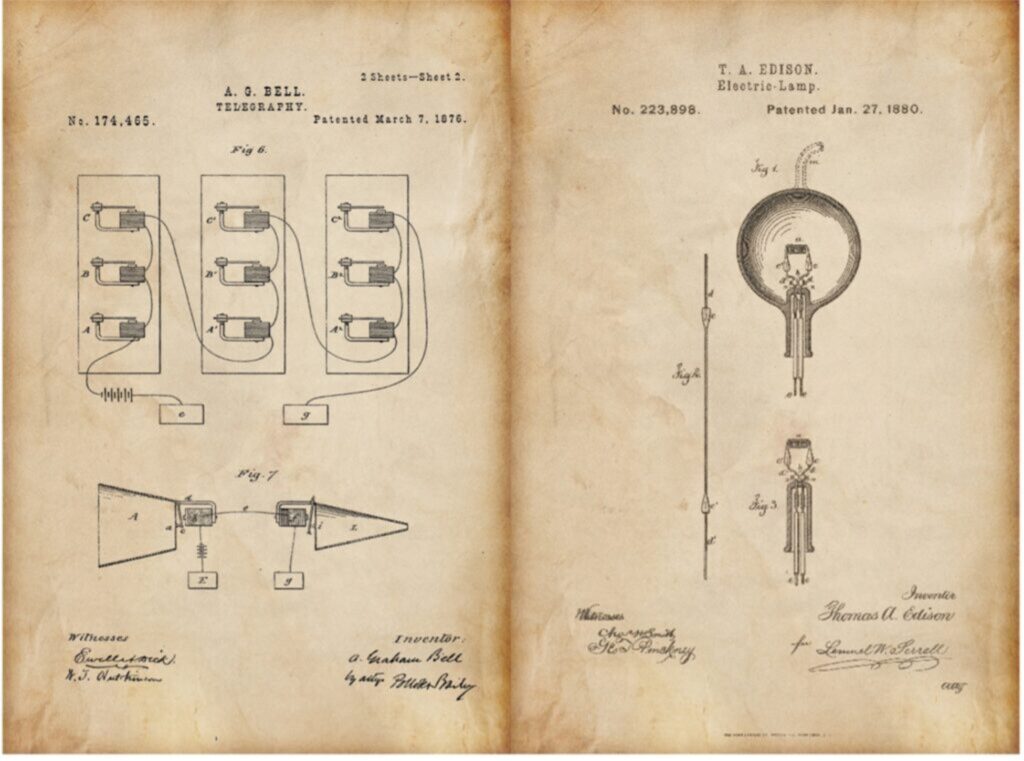
We like to talk about innovation like it’s spontaneous — a lightning bolt. And while the spark of innovation can feel like a revelation, innovation isn’t an accident. As the examples below show, innovation follows a pattern.
A creator:
- Identifies a need
- Develops a solution
- Tests their innovation
- Improves it over time
Freedom drives innovation. When people can experiment, refine ideas, and share solutions with others, society benefits.
For nearly 250 years, America’s commitment to liberty has empowered generations of innovators, builders, and dreamers to turn bold ideas into reality. The American Dream isn’t easy. It never was. But these 10 examples of innovation show what’s possible when people are free to create, work hard, and pursue opportunity.
WHAT ARE EXAMPLES OF INNOVATION?
Many innovations are practical solutions that break down barriers that make life and work cumbersome.
Some examples of innovation include the microchip, the telephone, and frozen foods. Each of these innovations improved everyday life.
And each of these innovations started as a small idea that was allowed to grow, improve, and scale over time.
We should think of innovation as a process that happens when people can test ideas, learn from results, and continuously improve.

10 INNOVATIONS THAT CHANGED AMERICA
There are many types of innovation.
New medical devices improve health. Innovative financial tools help build wealth. Other examples of innovation make life more enjoyable — like the swimming pool in summer.
America’s inventors, builders, and dreamers have changed our world for the better.
Here are 10 incredible examples of American innovation.
1. BOURBON WHISKEY: CRAFT INNOVATION THAT BUILT A NEW INDUSTRY
Innovation includes developing new and better means of production. These types of innovations can help turn small sectors into big industries.
Take whiskey, for example.
Elijah Craig refined distillation methods to create bourbon whiskey, turning a local craft into a distinct, scalable product enjoyed all over the world. What began as a small improvement grew into a major American industry with lasting economic impact.
Innovation grows when individuals can experiment, refine ideas, and bring new products to market without unnecessary barriers.
2. THE COTTON GIN: A SOLUTION THAT TRANSFORMED PRODUCTION
Another production improvement was Eli Whitney’s cotton gin.
This innovation made it faster to process cotton, dramatically improving efficiency. And Whitney’s work on interchangeable parts also helped shape modern manufacturing systems.
When people are free to solve practical problems, their ideas can improve entire industries.
3. THE TRANS-ALASKA PIPELINE: INFRASTRUCTURE THAT SCALED OIL AND ENERGY ACCESS
After production comes distribution. Innovation can also accelerate supply chains, helping products get to consumers more quickly.
The Trans-Alaska Pipeline addressed the challenge of transporting oil across difficult terrain. Its scale made energy distribution more efficient and supported economic growth.
For these advances to take shape and take hold, innovators need a clear set of rules. Indeed, large-scale innovation depends on the ability to build, adapt, and expand solutions across regions.
4. THE AIRPLANE: A BREAKTHROUGH THAT TRANSFORMED TRAVEL AND COMMERCE
When Thomas Jefferson and John Adams traveled to Europe to take up their respective ambassadorships, they had just one travel option: boat.
Journeys by sea were long, arduous, and, for many travelers, deadly.
Then came the airplane.
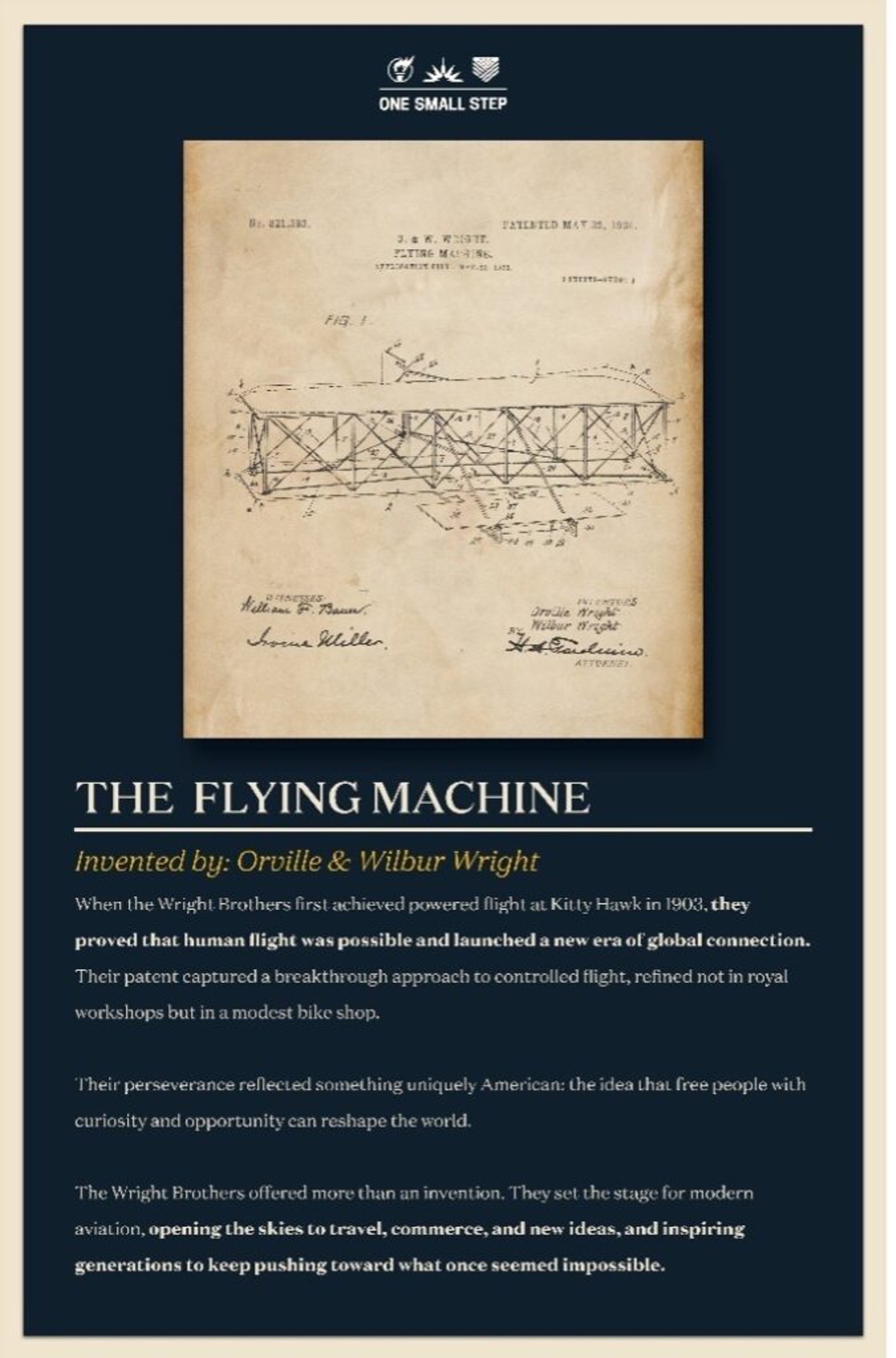
The Wright brothers solved the challenge of powered flight through repeated testing and iteration. Their success made long-distance travel faster and reshaped global commerce.
Breakthroughs often come from persistent experimentation. America’s history of innovation reflects the benefits of giving people the freedom to test and improve ideas over time.
5. THE COMBAT SUBMARINE: A NEW APPROACH TO DEFENSE AND ENGINEERING
Adversity, including life-and-death challenges, often inspires creativity and innovation.
The H.L. Hunley, the first combat submarine to sink a warship, introduced a new approach to naval warfare. By operating beneath the water’s surface, it demonstrated how engineering ingenuity could solve a complex military challenge and create entirely new capabilities.
Innovation often emerges when people are free to tackle difficult problems, test new approaches, and adapt their ideas to changing circumstances.
6. THE TOW TRUCK: A PRACTICAL SOLUTION TO AN EVERYDAY PROBLEM
Ernest Holmes Sr. was an innovator close to a problem. If you’ve ever been stuck on the side of the road, you have him to thank for your rescue.
Holmes invented the tow truck after struggling to move a stuck vehicle. His solution created an entirely new service industry focused on roadside assistance.
Many innovations begin when people encounter everyday problems and develop practical solutions that others need as well.
7. THE CHEESEBURGER: A SIMPLE IMPROVEMENT THAT CREATED NEW DEMAND
Innovation — finding something better, even yummier — can happen anywhere, even in your kitchen.
Louis Ballast’s idea to add cheese to a hamburger turned a simple product into something new. His small improvement to the plain hamburger became one of the most popular menu items in America and helped create new consumer demand.
Innovation often comes from small improvements that better meet people’s needs and preferences.
8. THE ICE CREAM CONE: A SPONTANEOUS IDEA THAT CHANGED SUMMER FOREVER
The ice cream cone is another innovation that, like the cheeseburger, has improved backyard summer barbecues.
How did it happen?
Ernest Hamwi ran out of paper cups for his ice cream booth at the 1904 St. Louis World’s Fair. His solution — combining a waffle cookie with ice cream — made serving easier and improved the customer experience.
Innovation often comes from adapting quickly to real-world situations.
9. THE SKYSCRAPER: A STRUCTURAL INNOVATION THAT RESHAPED CITIES
Cities have always faced the challenge of limited space. Earlier generations responded by building up instead of out.
William Le Baron Jenney’s steel-frame design enabled taller buildings, allowing cities to grow upward and transforming urban development and land use.
Innovation can make resources like space more efficient to use, but only when rules allow us to rethink what is possible.
10. THE WEARABLE PACEMAKER: A LIFE-SAVING MEDICAL BREAKTHROUGH
Innovation can give us space to live, and even save our lives.
Earl Bakken developed a wearable pacemaker to regulate heart rhythms, improving survival and quality of life for patients.
His work helped launch modern medical device innovation, paving the way for advances such as the implantable pacemaker and proving that when people act on urgent needs, innovation can quickly improve health outcomes.

WHY THESE EXAMPLES OF INNOVATION MATTER TODAY
The airplane, the cheeseburger, the skyscraper. Each of these innovations has a meaningful place in our lives today.
While we know some of the things that will shape our lives in the years to come, we can’t even imagine the products that innovators and creators among us are dreaming of now. And we certainly can’t anticipate the lightning-bolt idea that may hit us tomorrow!
What we can count on is this principle: Those dreams and creations have a better chance of coming true if government and society allow for experimentation, refinement, and solution sharing.
Innovation starts with a simple idea and the willingness to try something new. Explore how individuals across the country are turning ideas into impact — and find ways to support innovation in your own community.