Back in June 2024, the Supreme Court’s decision in Loper Bright Enterprises v. Raimondo tossed out 40 years of Chevron deference, the legal doctrine where court judges deferred to government agencies in how they chose to create and administer rules to enforce ambiguous statutes. Now, courts play a key role in interpreting laws rather than ceding authority to federal agencies, harboring power to invalidate or change regulatory actions that fail to execute the true intent and meaning of laws. This shift has already led to a reopening of rules established under Chevron deference, and the new legal reality will continue to lead to more.
The Trump administration acted quickly to address the Loper Bright ruling after he took office in January 2025. Executive Order 14192, signed in February 2025, instructed agencies to eliminate 10 regulations for every new regulation put in place. Then in April 2025, President Trump followed up with a memorandum, giving agencies a playbook for repealing regulations, instructing them to hold up existing rules against Loper Bright and nine other recent Supreme Court decisions. Rules that don’t hold up to the decisions are to be targeted for repeal, which is now underway at the Department of Labor (DOL).
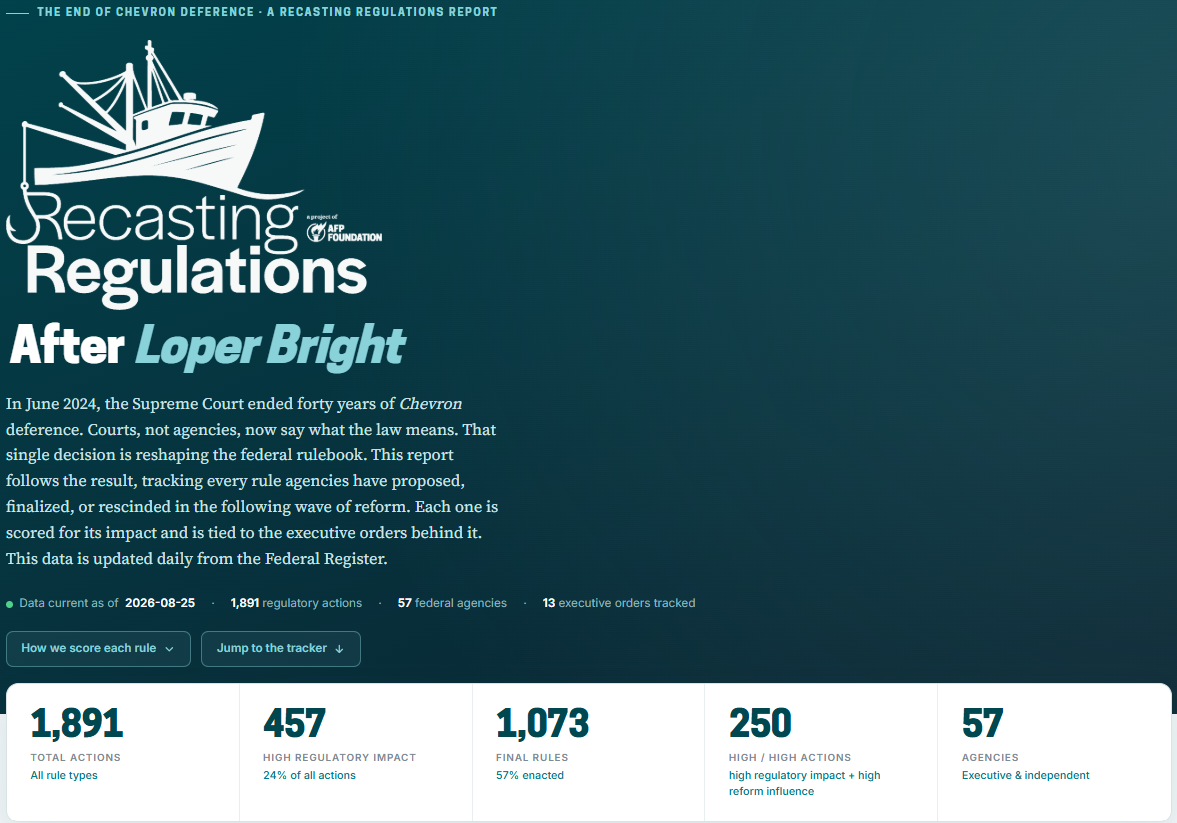
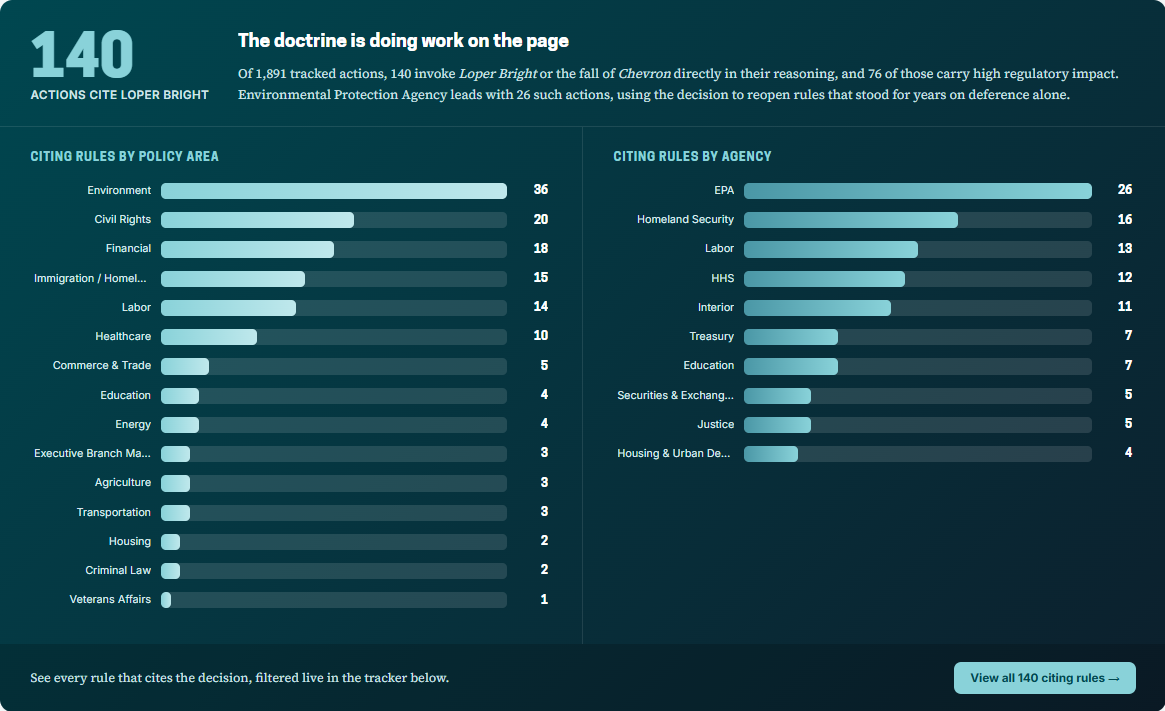
Americans for Prosperity Foundation has been cataloging the result rule by rule in its Recasting Regulations Tracker, which recently counted more than 1,800 regulatory actions across 57 federal agencies since Loper Bright, over 140 of which invoke the decision by name. At the Department of Labor alone, over a dozen of those actions cite Loper Bright directly, covering everything from mine safety to federal contracting to visa wage rules.
The Swinging Pendulum of DOL Policy
In recent years, significant DOL regulatory policies have swung back and forth on a pendulum depending on the party controlling the White House. DOL may continue to see shifts from one administration to the next, but the end of Chevron deference may finally help lead to more stable policy as rules are modified or rescinded to hold up in courts.
Examples of fluctuating policy include:
The overtime salary threshold rule determines what workers are entitled to overtime pay based on salary and duties.
- 2004 — President Bush’s DOL sets the modern methodology for the salary-level test that remains in use today.
- 2016 — President Obama’s DOL tried to more than double the threshold to $47,476, but a federal court blocks the rule just days before its effective date.
- 2019 — President Trump’s first-term DOL instead proposed a smaller increase of the threshold to $35,568.
- 2024 — Biden’s DOL raised the threshold again, but a federal court blocked the rule that November, citing Loper Bright in determining that DOL had exceeded its statutory authority.
- 2026 — On May 5, the Trump DOL formally ended its defense of the 2024 rule in court, leaving the 2019 number in place indefinitely.
Independent contractor (IC) status is decided at DOL through rulemaking on how the agency utilizes an economic realities test established through court precedent. The test determines whether workers who perform services should be defined as employees or ICs.
- 2015 — Obama’s DOL tightened the test through sub-regulatory guidance to make it harder to be an IC.
- 2017 — The first Trump administration DOL withdrew that guidance.
- 2021 — Trump’s DOL issued its own rule, built around two core factors: a worker’s control over the job and their opportunity for profit or loss.
- 2024 — Biden’s DOL finalized a six-factor replacement intended to diminish IC pathways after first delaying and then rescinding the 2021 rule.
- 2026 — On February 27, the current DOL proposed rescinding the 2024 rule (91 FR 9932) and reviving the 2021 approach, arguing the control-and-opportunity framework is the best reading of what the statute requires – an approach intended to be compatible with Loper Bright.
DOL in the Post Loper Bright Era
The DOL tug of war runs deeper than just those examples, but they highlight the chaotic nature of DOL regulatory policy, which is now operating under the microscope of President Trump’s executive orders in the post Loper Bright era. Since 2025, the Trump DOL has in fact directly cited Loper Bright for several high impact rules:
Joint Employer Liability
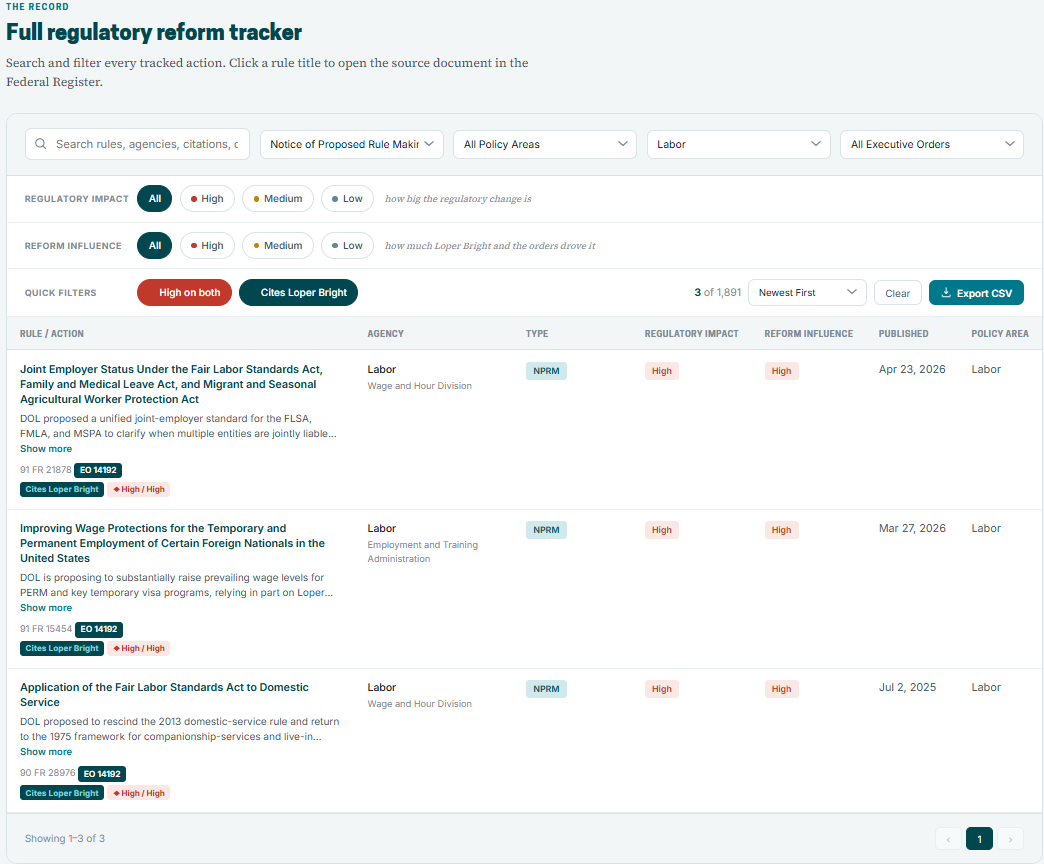
DOL proposed a single, unified joint-employer test on April 23, 2026 (91 FR 21878), replacing separate standards under the Fair Labor Standards Act (FLSA), Family Medical Leave Act (FMLA) and the Migrant and Seasonal Agricultural Worker Protection Act with one set of criteria on when two or more businesses share liability for workers. The rule cites Loper Bright in arguing that the rule executes the law based on precedent. Previous rulemaking efforts sought to undermine small business entrepreneurship with subjective standards for DOL to impose on disapproving workers and businesses.
Overhauling Union Reporting
DOL finalized an overhaul of union financial disclosure rules on June 1, 2026 (91 FR 32556). Larger unions must submit full LM-2 Long Form while smaller ones get simplified LM-2 reporting under revised thresholds. These forms publicize important union financial information on union spending, with budgets for the public including union members.
Rescinding Sixty Years of Affirmative Action Rules
Trump revoked EO 11246, the 1965 order requiring federal contractors to run race and sex-based affirmative action programs on his first day back in office in 2025 through EO 14173. DOL followed up with a proposed rule in July 2025 and a final rule in August 2026 formally rescinding the implementing regulations, with effective dates landing in September and October 2026. A final rule justifies it all under a section titled “The Affirmative Action Regulations Are Unlawful.”
Cutting Disparate-Impact Liability from Title VI
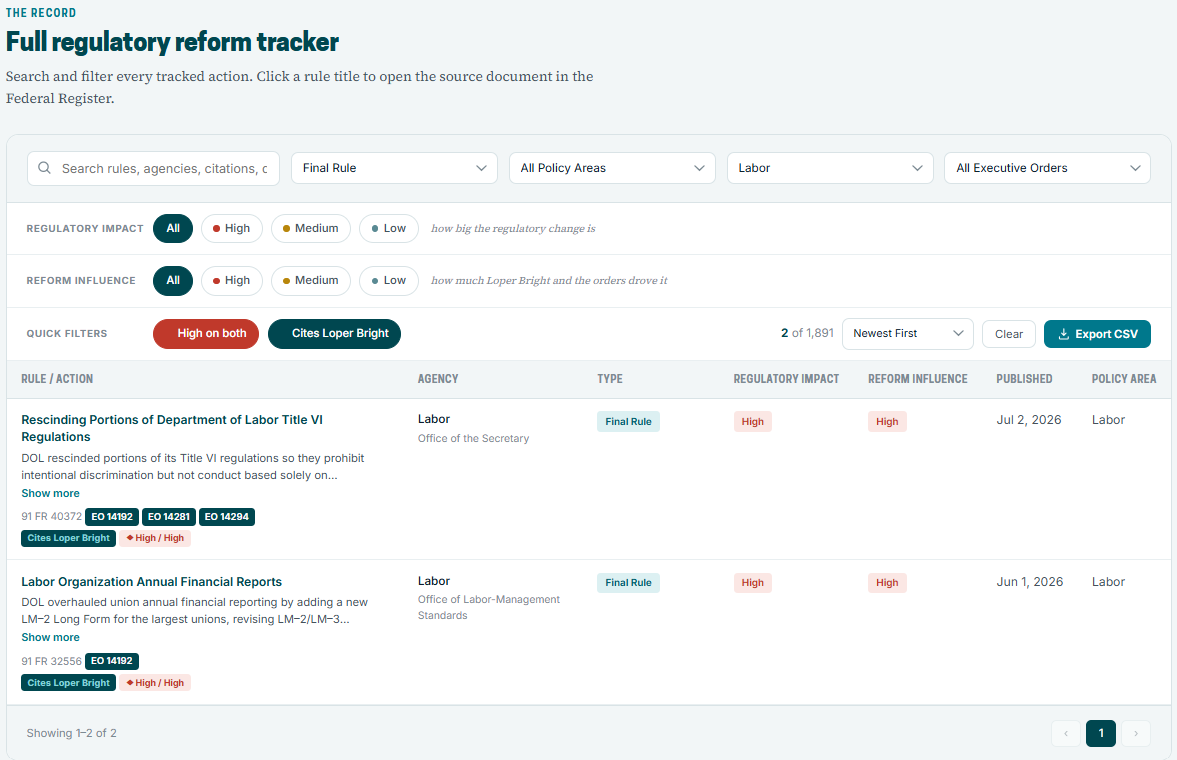
DOL also eliminated disparate-impact liability from its own Title VI regulations, effective the moment it was published on July 2, 2026 (91 FR 40372) The final rule quotes Loper Bright directly twice including a line that statutes have a “single, best meaning,” to argue Title VI’s text has only ever prohibited intentional discrimination. DOL has argued that the previous regulation had gone further than statute, letting DOL treat neutral policies as discriminatory based on unequal outcomes alone, with no discriminatory intent required.
The Post Loper Bright Era is Well Under Way, But Stay Tuned
The catalogue of DOL regulations under scrutiny by the Trump administration and courts may expand significantly, but AFPF through its Recasting Regulations Tracker is already highlighting the sea change under way across DOL and many agencies. In many instances agencies will settle on more permanent policies for workers and businesses to comply with, and it will be the responsibility of Congress to remove or fix laws at the root of bad but valid regulations in the aftermath.
Austen Bannan is an Employment Policy Fellow at Americans for Prosperity.