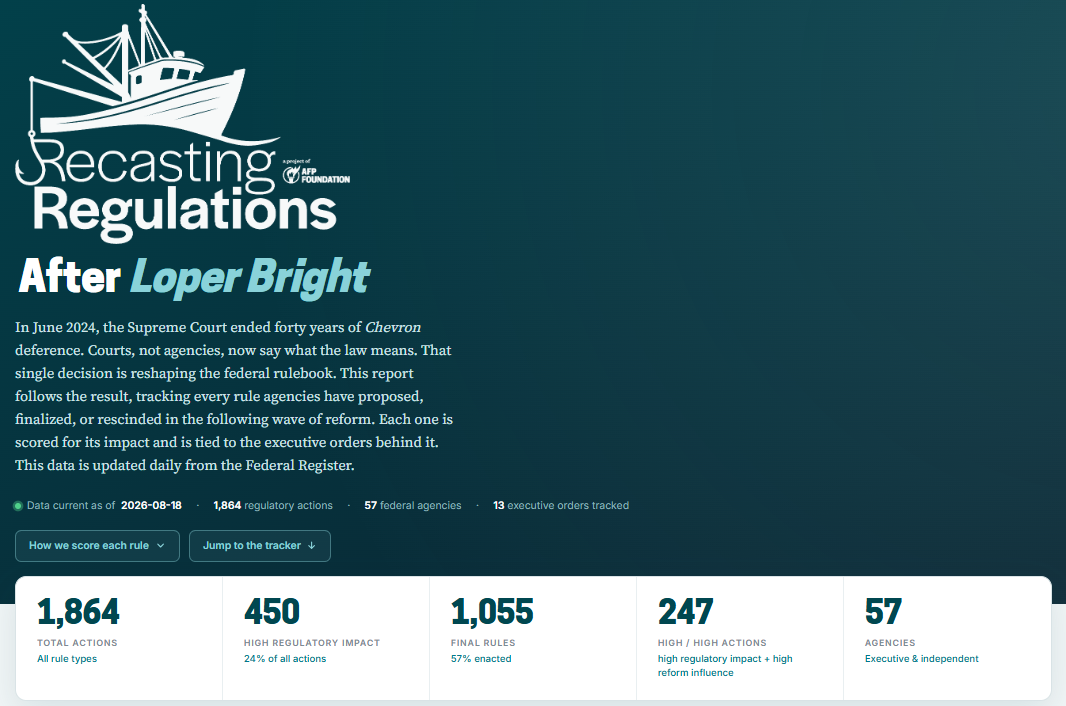
The 2024 Supreme Court decision in Loper Bright Enterprises v. Raimondo overturned Chevron deference. This returned interpretation of ambiguous laws to courts, who previously deferred to executive agencies on questions of unclear or ambiguous language. But how has the Loper Bright decision actually impacted executive branch regulations? Americans for Prosperity Foundation’s new Recasting Regulations Tracker showcases how regulations and rulemaking have been impacted, tracking every single proposed or finalized regulatory change since the Supreme Court decision. The Tracker highlights that unelected, unaccountable agencies no longer have the final say in legislation, including in housing policy, rather that these decisions ought to belong to elected lawmakers and the courts.
Fair Housing Act Reform
One regulatory change brought about by Loper Bright revises the Fair Housing Act’s regulation to affirmatively further fair housing. The Fair Housing Act calls for the HUD Secretary to administer the agency’s programs in a way that “affirmatively furthers fair housing” (AFFH). Prior to 1994, this responsibility was understood as a general commitment to ensure grantees further fair housing. However, since 1994, subsequent HUD secretaries have interpreted this to require significant analysis of “impediments to fair housing”, and to take action to overcome those impediments. In 2015, HUD published a final rule requiring grantees to conduct assessments of fair housing using an “Assessment Tool,” mandating even more regulatory burdens on state and local governments, and this requirement was brought back by the Biden Administration in 2021.
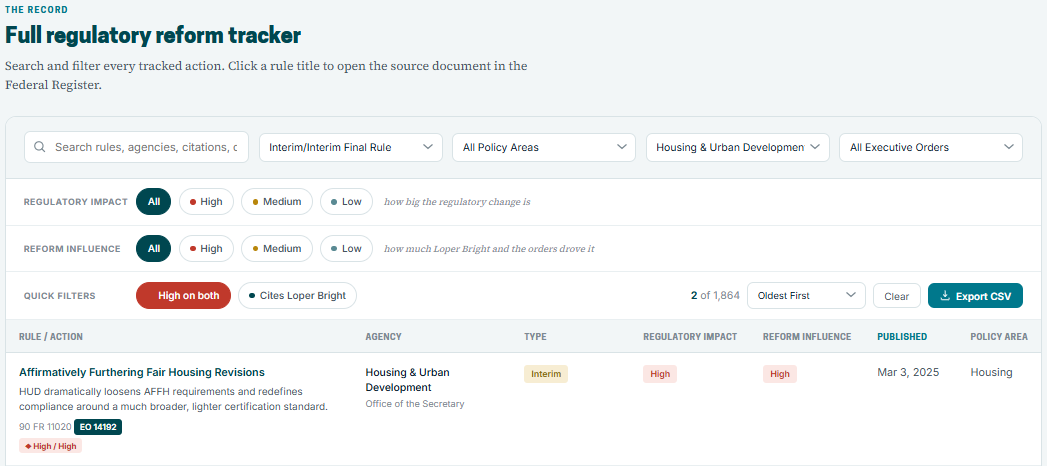
Yet, the Loper Bright decision recognizes that unelected agency heads are not the final say in interpreting laws. Therefore, consistent with Executive Order 14192, which directs federal agencies to repeal unlawful regulations in accordance with Loper Bright, HUD issued an interim final rule rescinding AFFH rules issued since 1994. This rule returns AFFH guidelines to their original, pre-1994 understanding, reducing regulatory burdens and excessive red tape on state and local authorities.
COVID Era Rule Repealed
Additionally, in February 2026, HUD issued an interim final rule on the Revocation of the 30-Day Notification Requirement Prior To Termination of Lease for Nonpayment of Rent. This change revokes a Biden administration rule requiring all public housing agencies and landlords with tenants receiving public rental assistance to provide at least 30-day notice prior to formally filing judicial eviction. The Biden-era interim rule had originally been justified by the previous administration due to the Covid national emergency, although the final rule was published by HUD in December 2024, well after the Covid-19 pandemic.
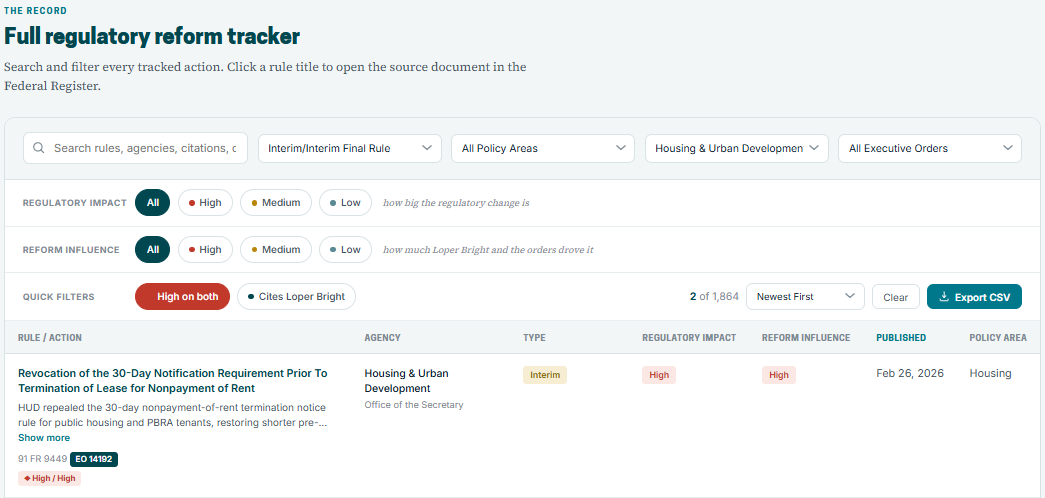
The Biden-era 30-day requirement caused significant financial hardship for landlords, who missed rental payments from tenants, and prolonged wait times for prospective tenants looking for affordable housing, as fewer non-compliant tenants were evicted. Utilizing Executive Order 14192, HUD issued an interim final rule repealing the Biden-era changes, reducing hardship for landlords and responsible renters alike.
Proposal to Remove Harmful Disparate Impact Standard
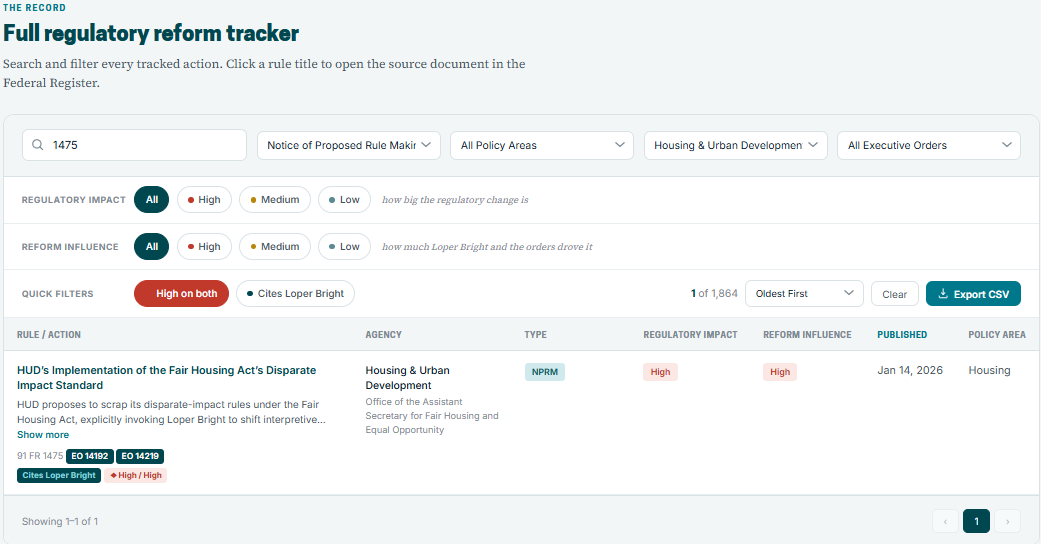
Earlier this year, the Trump administration proposed to repeal HUD’s Implementation of the Fair Housing Act’s Disparate Impact Standard. In 2013, HUD expanded the Fair Housing Act’s prohibition on housing discrimination to include disparate impact, meaning that discrimination in housing could be presumed due to disparate outcomes even if discrimination or bias was not the intent. The 2013 rule put the burden on defendants to prove lack of discriminatory outcomes, creating a “near insurmountable presumption of discrimination.” Citing Loper Bright and the end of agency deference, HUD is proposing to repeal this harmful standard and return interpretation to the courts.
How Loper Impacts Future Housing Legislation
The Loper Bright decision not only impacts existing regulations but has implications for interpreting newly passed legislation. The 21st Century ROAD to Housing Act, a sweeping, bipartisan housing bill, was enacted on July 11, 2026, and any legal challenges regarding unclear or ambiguous language will receive judicial, not agency, deference. Therefore, agencies should approach implementing the law by crafting common-sense guidance and regulations, as regulations that are “arbitrary” or “abuse of discretion” could be struck down by courts or repealed in accordance with Loper Bright.
The Recasting Regulations Tracker is a fantastic tool to see the regulatory impacts of the Loper Bright decision, including finding high-profile regulatory changes that were highly impacted by Loper Bright. Covering all regulatory changes across numerous policy areas, lawmakers, policy wonks, and scholars can all utilize the Tracker to inform work on cutting red tape and reducing the power of unelected bureaucrats.
Ilana Blumsack is a Senior Housing Policy Analyst at Americans for Prosperity.