For H.R. 7295 in the 119th Congress. 118th Congress version here.
Most members of Congress want to budget responsibly: put funds to best uses, respond to emergencies, and otherwise control borrowing.
The ideal Congress: They want to solve problems for the American people. They want to get along with their colleagues and work together on shared priorities. They believe in the Constitution, freedom, consent of the governed, prosperity, equality under the law, and other principles of human flourishing.
Congress curbed: Unfortunately, members have few legislative paths to advance their ideas. Anything significant requires Herculean efforts. Meanwhile, taxpayer funds are wasted on low priorities, and alarming amounts of waste, fraud, and abuse occur.
Americans harmed: A hobbled Congress hurts all Americans: higher prices and interest rates, less opportunity, more stress, and fewer ways to pursue the American dream.
Growing risks threaten greater hardships. Without a course correction, a federal debt crisis will inflict tremendous economic, security, and political carnage.
Fortunately, building up Congress to be what we need is entirely possible.
Sound Budgeting is Central to an Effective Congress.
Fragile: Today, budgeting is unproductive for the time it consumes. Each year, Congress tries to approve twelve separate appropriations bills covering one-fourth of spending. After drama and delay, it usually collapses into one or a few top-down packages after short-term patches, sometimes even after government shutdowns.
Partial: Annual appropriations leave revenue and most spending out of sight. Only 11 percent of federal health subsidies get appropriated. Those other policies are mostly out of mind, and they are entirely out of reach procedurally. Members of committees overseeing them have no regular way to manage their programs.
Partisan: Occasionally, one-party control of the White House and both houses of Congress unlocks budget reconciliation. Still, that approach is irregular and partisan.
Boom and bust: Experts continue to develop options and proposals, but Congress often cannot routinely use them. Long periods of stasis punctuated by sudden changes drive a feast-or-famine cycle for journalists, experts, and advocates.
Congress should do a Real Budget
Representative Blake Moore (R-UT) recently re-introduced the Comprehensive Congressional Budget Act (CCBA 1-pager, legal redline) to make congressional budgeting inclusive, bottom-up, and productive. It will help Congress manage all aspects of the budget (see Figure 1): revenue, discretionary and direct spending, tax expenditures, and more. Seeing how it all fits together will let members update federal activities more easily.
Figure 1: A budget includes all spending and revenue (FY2027, $ billion)
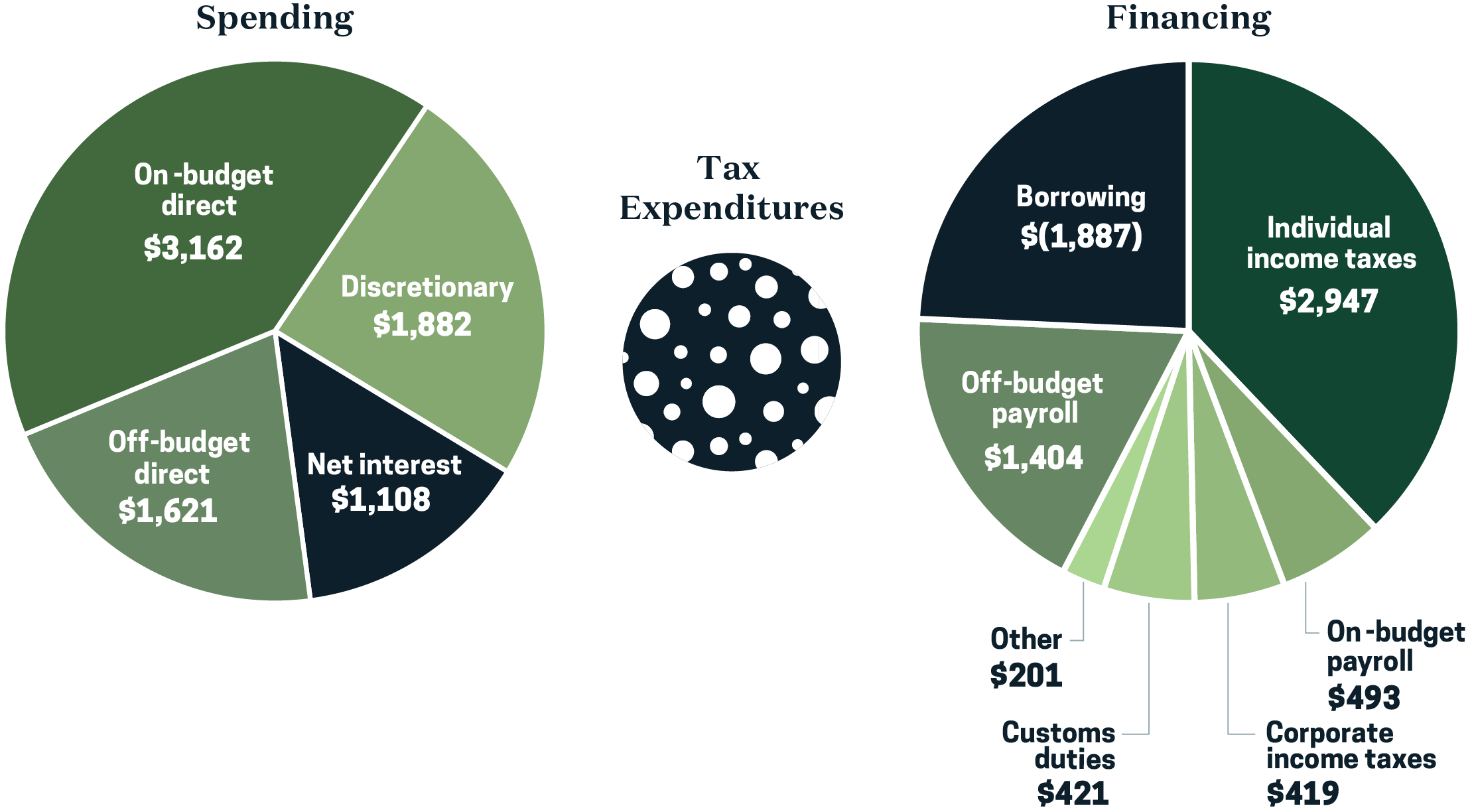
Source: CBO
Putting everything together helps Congress make better decisions. The American public worries about deficits and the debt, but a partial, broken-up process makes the tough-but-necessary work to control them politically perilous.
Political cover: A comprehensive budget gives members of Congress healthy kinds of political cover to survive—or thrive—as active managers.
- “Yes, but.” Combining everything lets members point to popular features like defense and infrastructure funding to help the medicine go down. Even within a committee, giveaways can soften the effects of takeaways.
- “It wasn’t me.” Some savings will come from committees on which a member does not serve.
- “Stand together.” Bipartisan deals will tamp down on partisan outrage machines.
- “One step at a time.” Regularly chipping away adds up. Big, sudden, scary leaps are not required. Half-baked ideas are easier to push to next year, and Congress has a clear way to fix any that slip through, especially if they don’t take effect right away.
Transparency: Budgeting means managing spending and revenue to add value. Seeing everything and having real paths to legislate lets members confront waste, fraud, and abuse and other misaligned policies.
Global best practice: The entire private sector budgets comprehensively. So do high-performing governments abroad including Sweden, Germany, Estonia, and Switzerland.
State success: U.S. state legislatures with more comprehensive budgets are more efficient. Adjusting for ideology, state legislatures that approach this standard spend less as a share of personal income than those with less coherent processes, and that is in addition to bond market discipline and balanced budget rules.
Constitutional grounding: The second part of Article I, Section 9, clause 7 of the U.S. Constitution says, “a regular Statement and Account of the Receipts and Expenditures of all public Money shall be published from time to time.” What is that, if not a budget?
Spirit of ’74: CCBA simply fulfills the vision of the Congressional Budget Act of 1974: effective congressional control of spending and revenue, setting national budget priorities, and getting useful information from the executive branch.
CCBA will give members of every committee with spending or revenue authority a regular chance to check up on and adjust programs.
Better angels: Getting to put proposals before colleagues and negotiate deals will encourage members to build stronger relationships and treat each other better. Today’s top-down, polarized culture will shift toward a bottom-up, problem-solving culture.
The use of knowledge: Anticipated, regular reviews of programs will deepen congressional knowledge, especially through the committees on which members serve. Budgeting to harness this expertise will get better results and let congressional leaders focus more on what only they can do. A more cohesive Congress will have a firmer foundation to check executive overreach or to partner with the president, depending on the issue.
Members will be more accountable for outcomes, but they will also have powerful tools to shape the results.
How Congress can do a comprehensive budget.
CCBA maps out how Congress can do an annual budget bill with all spending and revenue. More ways to contribute will help the budget be robust, earn broad support, and function well.
Budget Committee: The budget committees will coordinate and supervise other committees. They will build each year’s concurrent resolution on the budget using information provided by other committees. The budget resolution guides enforcement for contributions to the budget bill.
Appropriations: Appropriators will keep managing the twelve annual appropriations bills for “discretionary” spending. A comprehensive budget will help appropriations advance more regularly by giving members of other committees a greater stake in the annual process. It will also shift attention to areas of the budget that have been less scrutinized.
Authorizers: Authorizing committees will manage their direct (“mandatory”) spending programs. Members will be free to propose program changes during markups. Programmatic (i.e., non-budgetary) changes will generally happen separately, but greater insights and stronger relationships from better budgeting can support more regular authorizations.
The Senate Finance and House Ways and Means committees will manage the tax code: tax rates, bases, and preferences to meet a revenue target.
The CCBA will not prohibit spending or revenue legislation from moving outside of the annual budget process, but peer pressure on fairness and inclusion grounds would create powerful incentives to stay within that framework most of the time.
Grow the pie for all: Authorizers and appropriators will reprioritize funds within spending allocations and other budget resolution and statutory requirements. The budget committees will oversee committee submissions for consistency with all instructions. Naturally, committees that reflect each house’s membership will be best positioned to forge agreements that can pass.
Members will be able to pursue their priorities in committees and on the floor. Authorizers will gain the ability to manage their programs comprehensively and in coordination with the rest of the budget. Appropriators will have reinforcements from other committees to complete their work regularly. The budget committees will coordinate everything.
How would a comprehensive congressional budget process work?
CCBA’s modest changes will substantially improve federal budgeting.
Updates, not a replacement: CCBA keeps CBO’s Budget and Economic Outlook, the president’s budget request, existing congressional committee jurisdictions, views and estimates, the concurrent resolution on the budget, committee allocations, and more.
On that solid foundation, it builds more effective, holistic, bottom-up, Congress-empowered budgeting. CCBA’s changes are underlined in figure 2 and described below.
Figure 2: A comprehensive budget builds on existing foundations
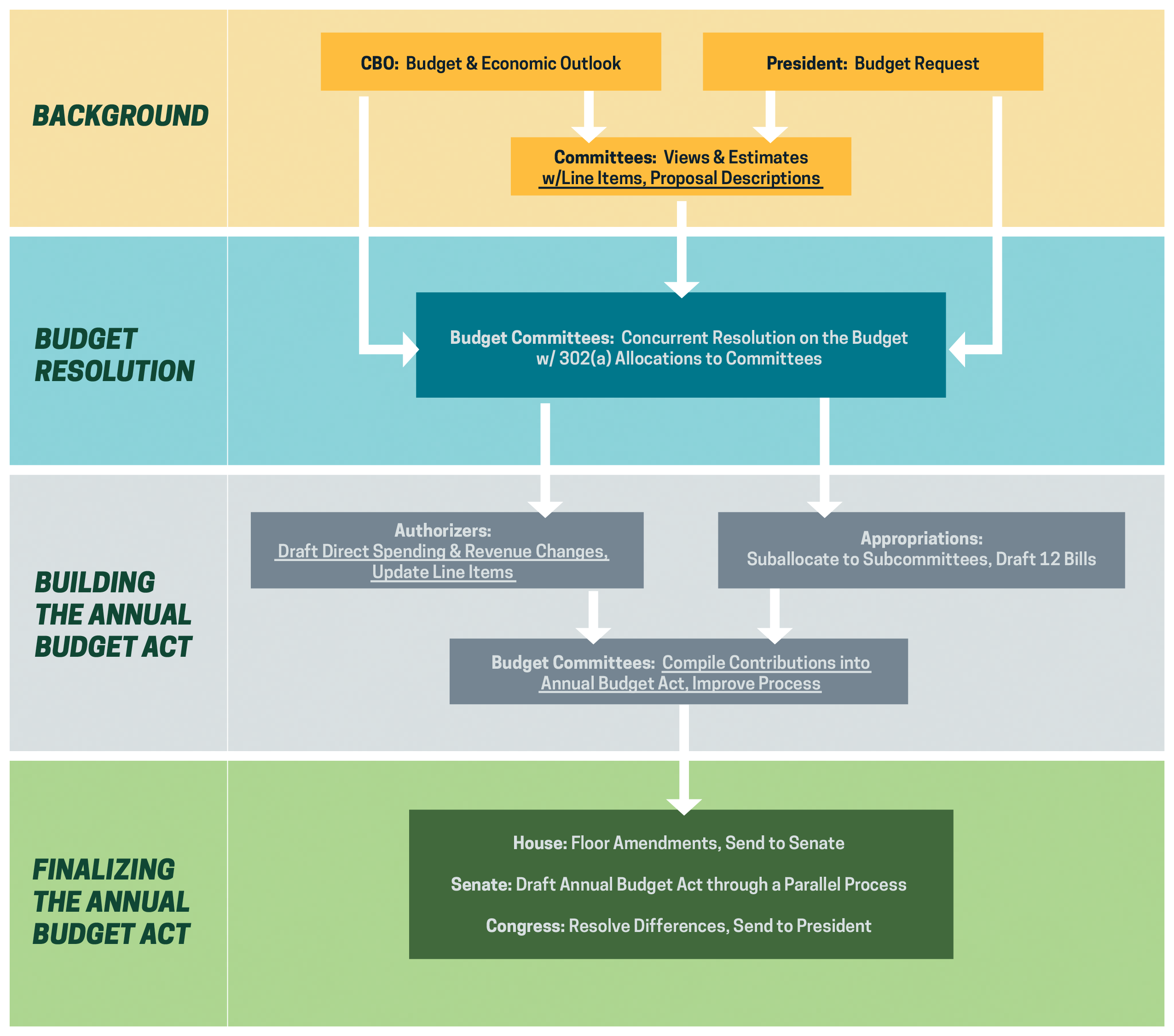
The Comprehensive Congressional Budget Act provides the key upgrades:
- Bulked-up “views and estimates:” Each winter, committees share their visions with the budget committees. These “V&Es” inform the budget resolution and what follows. Post-CCBA V&Es will include current-law line items for direct spending programs, which committees will get from CBO through the budget committees. Annual program management will make V&Es matter again.
- Social Security and postal payments on-budget: A complete budget covers all spending and revenue. Putting Social Security off-budget to avoid papering over deficits elsewhere made some sense when it ran surpluses, but now its assets will be gone in 2032, triggering 24 percent benefit cuts. Normalizing negotiations to protect important programs is a key feature of a comprehensive budget.
- Budget resolution: Allocations to committees, guardrails, and other budget resolution features will matter again with a comprehensive budget. A line-item budget will bridge the gap between aggregates and program details.
- Reconciliation: Budget resolutions can include reconciliation instructions alongside allocations for the annual budget bill.
- Backstop: If the budget resolution is not adopted by April 15, the Budget chairs will set committee allocations at baseline levels. This will keep the process moving, temper unrealistic expectations, and maintain the budget resolution as a governance framework.
- Committees check and adjust: Authorizing committees will join the appropriators in reviewing and adjusting their programs. Committees will seek information on relative values and tradeoff opportunities before developing proposals, adjusting line items, and sending proposals and amended line items to the Budget Committee.
- Budget Committees supervise: The Budget Committees make sure that committee contributions respect the rules. They can return wayward submissions to get fixed. If a committee does not submit a compliant submission by May 15, the Budget Committee will insert that committee’s current-law line items. This second backstop also keeps the process moving. Failing to get their legislation in the base budget bill will mean that a non-compliant committee’s members can only try on the floor.
- Budget Committees assemble budget bill: The Budget Committee bundles the twelve appropriations subcommittee bills, direct spending, and revenue submissions. This is also the Budget Committee’s opportunity to upgrade the budget process. The Budget Committee will report the budget bill by June 10 each year.
Budget endgame: Floor consideration and resolving differences between the houses will rely on established procedures. Even so, re-imagining the amendment process may better balance costs and benefits of amendments for major legislation like the annual budget act.
Complements: A complete budget will unleash pent-up congressional energy and talent. It will transform Congress’ culture and improve budget and governance outcomes. Further upgrades can support even better results:
- Leverage the State of the Union to get the president’s reports on time with the SUBMIT IT Act.
- End the unpopular cycle of shutdown politics with the Prevent Government Shutdowns Act.
- Adopt smart statutory budget targets like the Responsible Budget Targets Act.
- Upgrade automatic budget enforcement.
- Enact a well-crafted balanced budget amendment to the Constitution.
- Reclaim Congress’ power over emergency declarations with the ARTICLE ONE Act.
- Include debt limit increases in the annual budget act OR automatically suspend it when the budget has met reasonable targets.
Conclusion: Better budgeting will produce a better Congress
Budget officials Alice Rivlin and Pete Domenici’s 2015 “Proposal for Improving the Congressional Budget Process” for the Bipartisan Policy Center identified three key elements of budget reform: 1) The process should include all federal spending and revenue, 2) The budget process should be easy to understand and completed on time, and 3) Budget decisions should have the active participation of congressional leadership and the president. The CCBA substantially advances each element.
The Comprehensive Congressional Budget Act will help members of Congress become more effective legislators. Some will specialize in coalition building, some in policy development, and others in communications. All will have more ways to develop their strengths.
Committees will get to manage their programs within reasonable bounds. A comprehensive budget will support fiscal responsibility, reinvigorate representative government, and strengthen Congress’ independent policymaking prowess.
Kurt Couchman is a Senior Fiscal Policy Fellow at Americans for Prosperity.