Yesterday, Speaker Johnson invited President Trump to give the next State of the Union address on February 24, 2026. Meanwhile, the word on the street is that he will give Congress his annual budget request by or close to the February 2nd due date. The National Security Strategy is due then too, but President Trump beat the clock by releasing it in November.
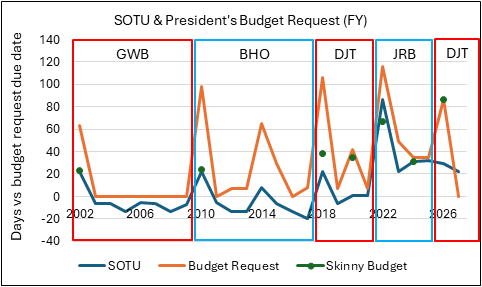
Congress needs the information in these reports for annual appropriations and security authorization legislation. The reports have often arrived late, especially during transition years (Figure 1). This year, for the first time in a long time, Congress may get what it needs from the White House to start its regular work on schedule.
Also encouraging, if Congress gets the budget request before the State of the Union, it will be the first time this century. That’s the right way: reports on the state of the union, then the State of the Union address.
Figure 1: Presidents’ budget requests have followed SOTU addresses
Source: GPO, American Presidency Project
Restoring timely president’s budget requests
Frustration with late budget requests has pushed members of Congress to propose legislation to mandate reports before the speech. In February 2024, when President Biden’s final budget request was due – all were late – Senator Joni Ernst and Representative Buddy Carter proposed the SUBMIT IT Act to require the budget proposal and the national security strategy first. Senator Roger Marshall’s Budget Reform Act of 2025 includes that language.
Such a law would establish consensus and common knowledge of the change so the president can better partner with Congress to serve the American people.
But why should the reports precede the speech? The SOTU, as both information and an address, is meant to show what is working, where policy could be better, and recommend measures for improvements. It’s a conversation between the chief magistrate and those who possess legislative powers. The discussion around the speech will be better if Congress, commentators, and the public have a better sense of the president’s priorities ahead of time.
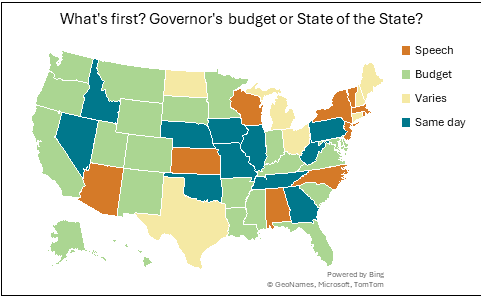
In the states, a plurality of governors submit a budget proposal to the state legislature before giving the State of the State speech (Figure 2). Sometimes the request and the speech are the same day, sometimes the speech comes first, and sometimes it varies.
Figure 2: Governors often provide a budget proposal before the speech
Source: NASBO, 2024/2025
Starting well, finishing well, and budgeting well in between
Congress getting complete and timely information from the president would help annual appropriations and security authorization legislation begin on time. It would make the State of the Union address more of a policy-focused dialogue.
To finish the budget cycle well, something like the Prevent Government Shutdowns Act by Senator James Lankford and Representatives Jodey Arrington and Jimmy Panetta would help. This bill would reverse the Carter Administration’s creation of shutdown disruption while keeping Congress and the White House Office of Management and Budget in DC until new annual appropriations are finished.
Wrapping up on time would help the next budget cycle start on time. So would revising the Presidential Transition Act of 1963 and other statutes to instruct OMB civil servants to support presidents-elect in preparing an initial budget request.
Finally, annual appropriations cover one-fourth of spending and one committee per chamber. A comprehensive congressional budget would give everyone a chance to manage all spending and revenue policies together through their committees and on the floor. It would dramatically improve congressional productivity, collaboration, and policymaking capacity.
For now, the likelihood that President Trump will give Congress a budget request on time and before the State of the Union is encouraging. Perhaps it’s even a sign that the federal government is turning the corner on dysfunction, just in time for America to celebrate its 250th birthday.
Kurt Couchman is a Senior Fiscal Policy Fellow at Americans for Prosperity.