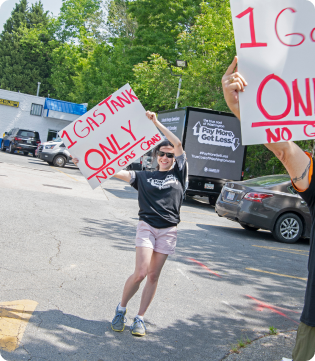
Last October, as millions of people marched in the No Kings rallies, Border Patrol agents and dozens of police departments were quietly running the plates of cars near the protests through a nationwide camera network, hundreds of times, with no judge involved. Automated license plate readers have become a national surveillance network that tracks not just where people drive, but what they believe. Until every search of that network requires a warrant, our freedom to speak, worship, and protest is at risk.
Companies such as Flock Safety, the largest vendor in the United States, mount cameras along public roads, usually at the request of police departments or local governments. Many went up years ago with little publicity. Each camera photographs every passing vehicle and records the time and location, and the car’s plate, make, model, and color. That data flows into a searchable cloud database, and agencies that join the network can query cameras far beyond their own jurisdiction. In one documented case, a single Texas sheriff’s office searched more than 83,000 cameras across the country. No judge signs off. An officer simply enters a license plate number and a one-line rationale for their search.
The Electronic Frontier Foundation obtained logs of more than 12 million searches run by over 3,900 agencies between December 2024 and October 2025. Buried in them were hundreds of queries tied to protest activity. More than 50 federal, state, and local agencies ran searches connected to demonstrations, and some targeted specific activist groups. Whatever you think of any protest, a government that records who drove to it is taking attendance on the exercise of a constitutional right.
A license plate trail is a diary you never agreed to keep. It shows how often you visit a church or a mosque, whether you parked near a gun show, a union hall, a party office, a support group, or a clinic. Follow a car for a month and you can sketch the driver’s faith, politics, health, and relationships. The First Amendment protects the right to hold and express those commitments without registering them with the state. A dragnet that infers them automatically hollows that right out.
The logs prove the point. Tulsa police alone logged at least 38 protest-related searches in 2025. Other records showed local police running more than 4,000 lookups on behalf of federal immigration authorities, often in states whose laws explicitly forbid such conduct. When no warrant is required, policy seems to be merely a suggestion.
Law enforcement in the United States has a history of abusing privacy rights. Fifty years ago, the Church Committee documented how the FBI surveilled civil rights leaders, ministers, and journalists. Agents used what they learned about private lives as leverage, most infamously in their anonymous letter pressuring Martin Luther King Jr. to end his own life. The lesson was simple: give government a file on everyone’s associations, and they will eventually use that information to silence people. Flock cameras are rebuilding those files, in higher resolution, on every road in America.
Our Founding Fathers anticipated this government overreach. In 1761, Boston lawyer James Otis stood in court against writs of assistance, the general warrants that let British officers rummage through any home or shop on a whim. He lost the case but lit a fuse. John Adams, watching from the gallery, later wrote that “then and there the child Independence was born.” The Fourth Amendment exists because Americans decided that officials must show cause, to a judge, before searching our lives. A database that lets any officer trace any driver’s movements is the general warrant reborn via software.
The United States is not the only country in which technology is being weaponized against privacy. In Moscow, facial recognition cameras at metro gates flag journalists and activists, allowing police to detain them before they can ever make it to protests. The rights group OVD-Info has documented nearly 600 uses of the technology against dissenters since 2021. America is not Russia. But regimes rarely build the machinery of repression from scratch. They inherit it, camera by camera, from people who promised it would only fight crime.
Defenders will say the cameras find stolen cars and abducted children, and sometimes they do. But no crime-solving benefit justifies a warrantless national tracking grid, and the surest fix is the one communities are already choosing: take the cameras down. By the ACLU’s count, more than 55 communities have ended Flock contracts in the past year. But some are simply swapping in near-identical systems from competitors. Denver’s council approved an Axon replacement in March just hours after Flock’s cameras came down. The threat was never one company’s logo. It is warrantless tracking itself, no matter who sells the camera. Legislatures should write rules that bind every vendor, or the industry will win by rebranding.
Wherever they remain, the ordinary discipline the Constitution already demands should apply at a minimum. Require a warrant before police search plate databases. Keep retention to days, not months. End default nationwide sharing, so a small-town camera does not feed a national dragnet. Publish audit logs and punish misuse. If a search cannot survive those tests, it was never about public safety. The next abuse may never surface in a public records request. It may be a quiet list of cars parked at a rally, a mosque, or a meeting someone in power dislikes. James Otis understood that liberty dies through routine searches nobody questions. Our answer should be his: no searches without cause, and no exception for cameras.
Hayley Bieron is a policy intern at Americans for Prosperity.