
This year federal, state, and local governments in the United States will collect around $9 trillion in taxes, or about one out of every three dollars Americans earn. If citizens had to pay these levies in a single installment there might well be another American revolution. To forestall this, governments break up this bill and assess it as smaller, often hidden charges. Federal and state gas taxes, for example, are embedded in the price we pay at the pump. Similarly, taxes on business end up in the price of goods we buy.
Indeed, most Americans never actually receive the money used to pay their two largest tax bills – those for income and so-called payroll taxes. This is because at the beginning of each year the companies they work for estimate how much they will owe. Payments are then euphemistically ‘withheld’ – or deducted – from their paycheck each pay period.
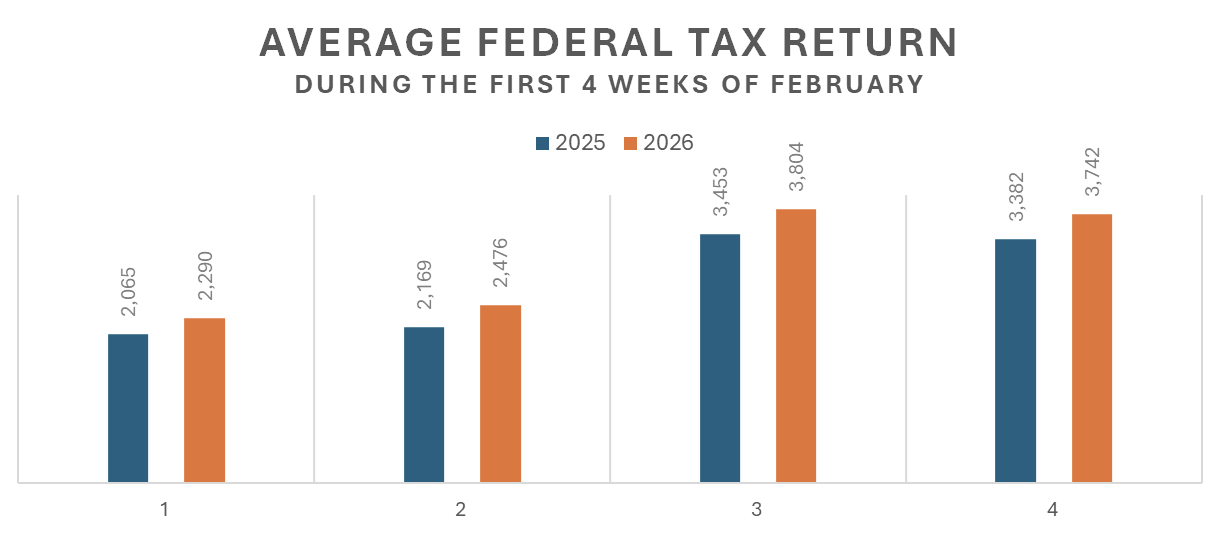
While withholding generally obscures tax burdens, this filing season it gives taxpayers some idea as to the federal individual income tax savings they received last year from the passage of the Workings Families Tax Cuts Act. This is because while the individual provisions of the bill were mostly retroactive to January 1, 2025, the rules governing withholding were not altered and based on prior law.
The earliest an individual can file a tax return is in late January. By early February they begin to be processed by the Internal Revenue Service. The figure above shows the average size of refunds processed during the first four weeks of February this year and compares them to last year’s filing season. It shows that during the first week of February the average tax return was $2,290, or $225 larger than last year. By the end of the month the size of the average tax return had grown to $3,742, $360 larger than last year.
The size of refunds will likely continue to grow as more Americans file their tax returns. It is also important to keep in mind that the WFTC Act cut other, less obvious taxes as well so Americans will also enjoy indirect relief. They will also benefit from provisions in the Act that spur economic growth and boost paychecks.
Patrick Fleenor is a Senior Tax Policy Fellow at Americans for Prosperity.
© 2026 AMERICANS FOR PROSPERITY. ALL RIGHTS RESERVED. | PRIVACY POLICY
Receive email alerts to learn how to get involved