
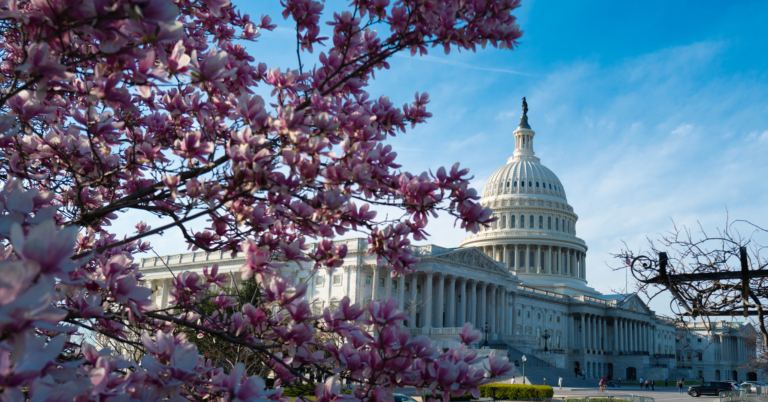
On March 18, 2026, the U.S. House of Representatives considered a proposed next-generation balanced budget amendment (BBA) to the U.S. Constitution. It failed, 211-207. Constitutional amendments need two-thirds. All Republicans voted for it, and all Democrats but one opposed it.
The vote fulfilled a commitment to some House members on final consideration of the Working Families Tax Cuts Act. It followed a hearing in December and a markup in February of House Joint Resolution 139 by Representative Andy Biggs.
Every BBA previously considered in Congress would have required annual total balance: total spending does not exceed volatile revenue each year, except for emergencies. In addition, they would limit spending based on “outlays,” which occur when agencies spend money. Congress does not control outlays directly, and this standard would create management difficulties.
H.J.Res.139 proposes balance over the business cycle or over the medium term. “Expenditures” would be based on a rolling average of the prior three years of revenue. Budgeting would be far more stable, predictable, and countercyclical than with annual balance. The Principles-based BBA and a debt limit amendment can also allow “structural” balance.
House BBA votes in 2018 and 2026 followed sweeping fiscal legislation through budget reconciliation and had scant support from Democrats. By contrast, votes in 2011 and in 1995 saw 25 and 72 Democrats support BBAs on final passage, respectively. The 2011 vote followed the bipartisan Budget Control Act of 2011 and the Tea Party wave during divided government. The 1995 vote followed the Republican takeover of Congress, it built on decades of bipartisan advocacy for a BBA, and the vote occurred during a 15-year period of usually-bipartisan deficit reduction. President Reagan’s advocacy for a BBA helped both houses vote on BBAs for the first time in 1981 and 1982, again during divided government.
Countries and states have often adopted budget rules to help recover from periods of fiscal stress. Credible commitments to control borrowing gave bond buyers confidence to lend on better terms. The federal government has not yet faced a bond market reckoning despite debt downgrades and other mounting pressures.
Since 1957, state legislatures have applied to Congress for an amendment convention for a BBA. Some believe they reached two-thirds in 1979 and that Congress has neglected its duty to call the convention. Pending litigation may test that claim, and if it succeeds, state legislators could be writing the BBA for Congress.
In 1995, BBA markups considered many amendments, senators considered many floor amendments, and the House used a competitive “queen of the hill” rule on the floor. The House passed a BBA 300-132, and the Senate’s 66-34 vote (Dole’s “no” was only so he could move to reconsider) was one away from sending it to the states.
In 2011, House Republicans marked up a conservative BBA before the BCA but afterwards brought back the consensus 1995 language to the floor. Democrats were only marginally involved. It failed.
The 2018 House BBA that got a vote resembled the 1995 and 2011 voted-on BBA but without a markup and just a floor vote. This year’s next-generation, conservative BBA did not appear to be a bipartisan effort.
Looking beyond some Democrats’ spicy rhetoric about Iran, immigration, deficits, and more, several policy objections were clear.
No one seemed to criticize business cycle balance or moving from “outlays” to “expenditures” or from full balance to potentially primary balance. Indeed, in the 112th Congress (2011-2012), 14 Democrats including progressives cosponsored the original Business Cycle BBA alongside dozens of Republicans. Leaving the president’s budget request in statute instead of trying to put it in the Constitution also did not come up.
First, section 4 would require two-thirds of both houses to create new taxes or to increase tax rates. Though some Democrats mischaracterized this provision, many believe it would create asymmetry between spending and revenue changes.
True, this requirement may have won a few Republican votes: in 1995, two House Republicans opposed the consensus BBA on final passage for the lack of a supermajority for revenue increases. In 2011, four House Republicans opposed it, but more due to the problems inherent to annual balance. Six House Republicans opposed in 2018 for a combination of reasons.
Second, section 3 would allow simple majorities to declare war and fund it, a lower threshold than the standard two-thirds requirement for other emergencies in section 2. Some claim it could even encourage war.
Third, section 6 would require balance within five years of ratification. Today’s high deficits would make even a five-year path to primary balance ambitious.
Finally, although it was absent from debates, the business cycle adjustment for “changes in the population of citizens of the United States” instead of simply “population” may have touched a nerve related to ongoing immigration concerns.
If Republicans are unified, a constitutional amendment needs a bare minimum of roughly one-third of Democrats. Broader support would be ideal, of course.
Clearly, the moment for broad support for a BBA is not now. Democrats who spoke on the floor and during the Judiciary Committee were not interested in the design of the rule, other than the supermajority for some revenue increases. The speakers railed against the Iran conflict, immigration actions, claimed that Democratic presidents are fiscally responsible and Republicans are not (no, the Speaker matters much more), and disingenuously said a Republican trifecta should just balance the budget (pretending the Senate filibuster does not exist).
When the politics improve, support will come from being engaged, from being at the table, and from having a say in the product. Timing matters too. Some believe that a balanced budget amendment will only come when state legislatures or the bond markets force Congress’ hand.
If so, sorting through the options to find a path forward is well worth doing. I discuss these issues and implementation in detail in Fiscal Democracy in America: How a Balanced Budget Amendment Can Restore Sound Governance.
A balanced budget rule can be a normal, neutral tool of sound governance. To succeed, members of Congress must be ready to think of it that way.
© 2026 AMERICANS FOR PROSPERITY. ALL RIGHTS RESERVED. | PRIVACY POLICY
Receive email alerts to learn how to get involved