State judges have an enormous impact on the law and rights of individual citizens. While major federal appellate and U.S. Supreme Court decisions attract attention, most of our disputes are resolved in state courts. As judicial systems are critically important in securing limited government, protecting equal rights, and upholding human dignity, all citizens should care about how we select judges.
This document examines: (i) what makes a good judge, (ii) the methods of judicial selection across states, and (iii) the relative effectiveness of those systems at selecting judges.
Key Takeaways:
- Judges should be competent, fair, and believe in originalism and textualism.
- A judicial selection system should balance accountability with judicial independence.
- The federal system of judicial selection is preferred. Partisan judicial elections are also effective. The so-called Missouri Plan or “merit selection” is the least effective method of judicial selection.
Action:
- Eliminate the Missouri Plan where it exists.
- Allow judges to disclose party affiliation to better inform voters.
- Advocate for judges who align with an originalist and textualist judicial philosophy.
Download the PDF
I. What makes a good judge?
A judge’s job is to faithfully interpret the laws as written and not impose judicial policy preferences. To do that successfully, every judge must have the aptitude and character commensurate with judging — that means every judge should combine education, experience, intellectual rigor, understanding of the law, appropriate temperament, compassion, and commitment to justice. Anyone whose job is to select a judge, whether elected official, board member, or voter, should reject judges who do not meet these basic standards.
Judicial Philosophy
Another critical element to a judge’s thinking is judicial philosophy. This is the “toolkit” a judge applies when interpreting the law. While there are myriad flavors of judicial philosophy, there are two primary schools of thought: “living constitutionalism” or its cousin, “common good constitutionalism,” and “originalism and textualism.”
Living Constitutionalism: This philosophy hinges on the idea that the meaning of constitutions, or even statutes, changes over time (outside of the amendment process) to reflect a particular purpose.
This is a flexible approach; it allows judges to reinterpret the meaning of laws as they see fit, but it leads down a perilous path to “judicial activism.” Judges in this school often first look for the “right outcome” — the judge’s moral or political sense of how a case should be decided — and then apply the law as necessary to reach that outcome.
This philosophy does not comport with the proper role of the judiciary. Judges’ personal or political proclivities should be left at the courtroom door. Litigants should expect regularity and fairness in the courtroom. Judges should say what the law is; political questions about what the law should be are left to legislators and voters.
Originalism and Textualism: This philosophy follows the principle that a judge’s job is to interpret the law as written (i.e., textualism) and that the meaning of that text is the public meaning it had when the law was enacted (i.e., originalism).
This is a more rigid approach. It recognizes the basic principles of separation of powers — that it’s the legislature’s job to enact new laws and not a judge’s job to legislate from the bench. It requires a judge to understand and occasionally rule in ways that are counter to their moral or political sensibilities and to trust legislators and voters to answer those questions.
This philosophy is aligned with the principles of human progress. By setting a level and fair playing field, it provides dignity to anyone entering a courthouse. They know they will be treated equally under the law. A stable, principled legal order creates the conditions for bottom-up flourishing. People are able to freely exchange ideas, resources, and opportunities without fear of arbitrary judicial coercion or ever-changing legal conditions.
Accountability and Independence
There are two final qualities that a judicial selection system must have: accountability to the citizenry and counter-majoritarian independence from political pressure. These factors are less about the qualities of a judge and more about the political system’s reaction to judicial rulings.
Accountability: A judicial system should have some accountability to the citizens it serves. For a judicial system — where every decision will have a winner and a loser — it is crucial that citizens believe the system is fair. To that end, there should be a way for citizens to express their displeasure with the judges selected, either directly or indirectly, at the ballot box.
Independence: A judicial system should protect the rights of minorities from majoritarian impulses. To that end, it needs to have some insulation from majoritarian instincts that will seek short-term results at the expense of long-term erosion of rights. There should be some distance between direct democracy and judicial selection.
Both values are important. Systems that select judges necessarily need balance to strive to capture both accountability and independence.
II. How do states select their judges?
Every state selects judges in its own way, but the systems can be broadly grouped into five primary selection methods:
Gubernatorial appointment: This system operates like the federal model. Judges are nominated by the governor and approved with the consent of the legislature (either one or both houses, depending on the state).
Partisan elections: Judges are elected directly by voters. Judicial candidates are allowed to list their partisan affiliation (if any) on the ballot like any other elected official. They are also free to campaign like other elected officials.
Nonpartisan elections: Judges are elected directly by voters. Unlike candidates for other offices, judicial candidates are prohibited from revealing their partisan affiliations. In many states, additional restrictions specific to judicial candidates further limit their ability to associate with a political party.
Missouri Plan: A nominating commission selects a slate of judicial candidates and submits that slate to the governor. The governor must choose a judge from that list. Nomination commissions themselves are selected in varying ways — these commissions are usually comprised of a mix of state bar associations, governor-appointed citizens, and current members of the judiciary.
Legislative elections: Judges are selected by a majority vote of the state legislature. Only two states (Virginia and South Carolina) select judges this way. Both states have idiosyncrasies that make them act in practice quite differently. Virginia’s system behaves more like the federal model and South Carolina’s system behaves more like a Missouri Plan state.
III. Judicial selection systems and judicial quality
Judicial Aptitude and Judicial Philosophy
When it comes to judicial quality, perhaps the most surprising finding is that no judicial selection system fares better than any other. As one researcher put it:
There is no evidence that any method of selection produces more competent judges than any other. This surprises people—it surprises me—but scholars have looked at it every way we know how—years of experience, ranking of law school, productivity, citation of opinions in other jurisdictions, clarity of opinions—and there is no good evidence one system produces better judges than any other.[1]
When the Missouri Plan began to take hold as an alternative selection method in the 1960s, this was contrary to expectations.
As the name implied, merit selection was designed to ensure that judges would be selected on the basis of professional merit, including professional qualifications, experience, legal expertise, impartiality, and temperament.[2]
On its own terms, merit selection, as the Missouri Plan is sometimes dubbed, has failed at its most important goal: producing more meritorious judges.
Since no selection system consistently produces better judges from the standpoint of legal aptitude, we should look instead to judicial philosophy.
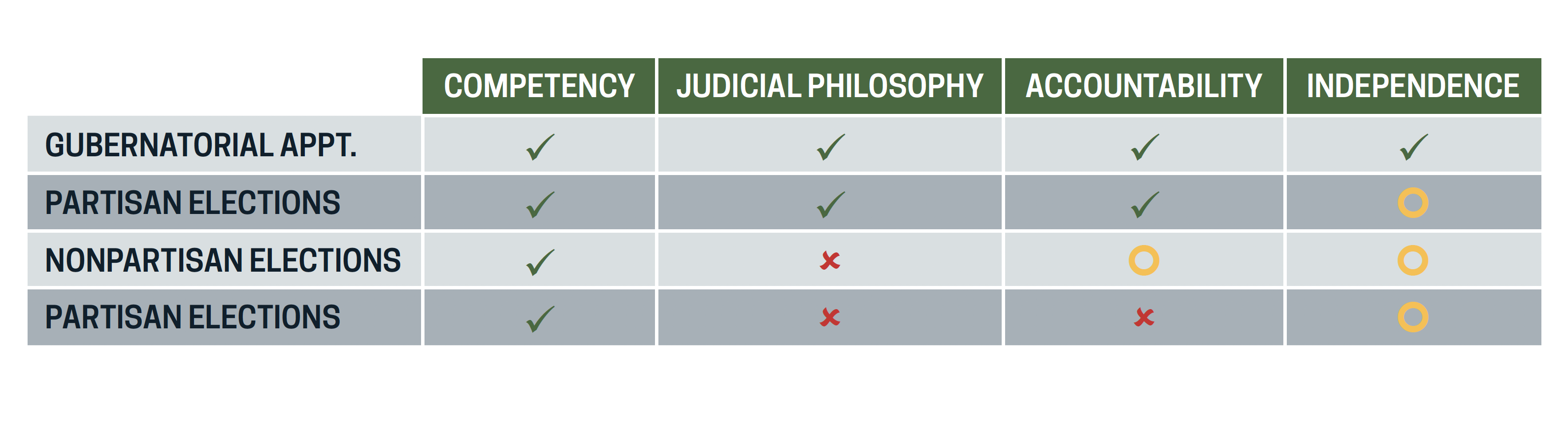
Here, the difference in results is clear: States under the Missouri Plan and nonpartisan elections have produced far fewer originalist judges. States with gubernatorial appointment and partisan elections have produced a more even mix of originalist and non-originalist judges.
Accountability and Independence
Since a good selection system must have both judicial accountability to citizens and judicial independence, it must balance these two competing factors. Each system shows different strengths and weaknesses:
- The Missouri Plan fails on both fronts. It provides voters with next-to-zero accountability — if the commission installs a judge that they don’t like, they have no recourse to change the decision or remove the commission members who made the bad decision, and their only avenue to remove a judge, a retention election, has proven completely inadequate. Ninety-nine percent of judges are retained.But more important than the results, these elections fail to give voters a voice. If a judge is not retained, the process repeats. At no point do voters actually have a say in choosing the new judge. And because the commission can continue to offer choices to the governor that he or she would not choose, even the voters’ choice of the governor provides them no real role in the selection of their judges.The supposed benefit of this should be judicial independence. But it turns out that judges are subject to outside forces under the Missouri Plan. They are responsive to the bar associations that dominate the selection commissions. As with judicial philosophy, research shows that judges reflect the values that comport with the bar associations that help choose them.
- Partisan elections suffer from the same lack of independence as nonpartisan elections. Since judges must run for election and re-election, some worry that they would be susceptible to majoritarian pressure. But they do significantly increase the accountability and legitimacy of the court. Research shows that judges in partisan election states are most representative of the citizens of that state.
- The Federal Model best balances legitimacy and accountability with judicial independence. Voters can hold governors who appointed (and legislators who approved) judicial nominees accountable for those decisions, and legislators and governors can and do advertise to voters the kind of judges they will look to appoint. But judges themselves have a level of separation from majoritarianism and can better exercise their judicial judgment and philosophy, independent of direct electoral pressure.
IV. What can you do?
- Eliminate the Missouri Plan
The Missouri Plan is a failed experiment — it was intended to get more competent and independent state judiciaries, but it has done neither. Most judicial selection commissions are enshrined in state constitutions, so engagement in state constitutional reform is often necessary to undo this failed top-down system. - Advocate for legislative change
allow judges to fully inform voters about who they are, including their party affiliation. Party affiliation is one of the most valuable pieces of information a judge can give a voter. To restrict judicial speech and association in the name of unrealized “independence” from partisan politics is wrong; these restrictions should be eliminated. - Advocate for better judges
Regardless of the system, voter education about judicial candidates and legislative and gubernatorial outreach make a difference in which judge is appointed and confirmed. Those who are qualified should also seek to serve on judicial nominating commissions to improve the quality of these selections. Judicial selection systems are not set in stone — there is always an opportunity to make a small difference toward producing a better state judiciary.
[1] Fitzpatrick, Brian T., Judicial Selection and Ideology (January 31, 2017). Oklahoma City University Law Review, Vol. 42, No. 1, 2017, Vanderbilt Law Research Paper No. 23-07, Available at SSRN: https://ssrn.com/abstract=4373382.
[2] Caufield, Rachel Paine. (2010). “What Makes Merit Selection Different?” Roger Williams University Law Review, Volume 15 (Issue 3).